INTERNATIONAL ENVIRONMENTAL LAW AND ECOLOGICALLY SUSTAINABLE DEVELOPMENT
🔊 Listen to Chapter 3, its questions and its answers — JUNI British female voice
How international rules become Australian law; sovereignty and transboundary harm; ESD; climate change; marine pollution; biodiversity; and the whaling litigation.
This chapter incorporates the complete Week 3 seminar material presently supplied, together with the Week 2 tutorial learning carried forward from Chapter 2. The law, cases, treaties and statutory links have been checked against authoritative sources as at 30 September 2026. Chapters 4 and 5 now extend this foundation through the full EPBC referral, assessment, approval, conditions and enforcement framework. Check current legislation and transitional provisions for live projects.
International environmental law can look remote from ordinary Australian legal practice. It is not. Many of the rules that govern threatened species, World Heritage, migratory wildlife, ozone-depleting substances, climate obligations, marine pollution and biodiversity exist in Australian legislation because Australia has undertaken international commitments and the Commonwealth Parliament has legislated to give those commitments domestic effect. Chapter 3 therefore teaches a lawyer to move across legal levels rather than treating international and domestic law as separate subjects.
The central question is always practical: what is the environmental problem, what legal rule answers it, why does that rule bind the relevant actor, and what must the client do next?
3.1 Why environmental problems cross legal borders

Political borders are human constructs. Air pollution does not stop at a customs checkpoint. Rivers flow through several jurisdictions. Migratory animals move across national boundaries. Greenhouse gases mix in a global atmosphere. Marine pollution can travel enormous distances. A decision made within one country can therefore create environmental consequences in another country or in areas beyond national jurisdiction.
This creates a structural problem. States are sovereign, but environmental systems are interconnected. International environmental law develops rules for managing that tension. It does not abolish sovereignty. Rather, it supplies rules through which States accept duties, coordinate conduct, exchange information, prevent or reduce harm and resolve disputes.
3A. Begin with the physical fact: nature crosses political borders
The Week 3 seminar begins by asking students to notice a contradiction. States claim sovereignty within legal borders; rivers, migrating species, ocean currents, air pollution and greenhouse gases do not obey those borders. A chemical spill in one country can destroy fisheries in another. Whales may move between international waters and maritime zones. A country's fuel and energy policy affects atmospheric concentrations far beyond its coastline. The existence of an environmental problem does not itself tell us which State has jurisdiction, what law applies or who can enforce it. Those are separate legal questions.
In private international law, the dispute may involve companies, individuals and harm across borders. The lawyer asks which court has jurisdiction, which substantive law governs, how documents and witnesses can be obtained and whether a judgment can be recognised or enforced elsewhere. The lecturer's Baia Mare cyanide spill example makes those issues real. A Romanian mining enterprise used cyanide in gold processing, with Australian-linked corporate participation. A tailings-system failure caused pollution crossing into Hungary's waterways. Even if everyone agrees that serious damage occurred, litigation can still be complicated by competing courts, different national rules and causal evidence. Avoid assuming that an international environmental catastrophe automatically gives victims a straightforward international-court claim.
Public international environmental law, in contrast, regulates the relationships, obligations and conduct of States and international organisations. Relevant norms arise from treaties, customary international law and general principles, assisted by decisions and scholarship as evidence or subsidiary means. Article 38(1) of the Statute of the International Court of Justice is a useful organising reference, but it is not a domestic environmental approvals code. When advising an Australian developer, identify whether an international instrument has actually been implemented in Australian legislation. A treaty obligation addressed to Australia and a direct statutory prohibition on a company are different things.
3.2 Private international environmental disputes: jurisdiction, governing law and enforcement
Private international law, often called conflict of laws, deals with disputes involving private actors and a cross-border element. The environmental dimension does not change the core conflict-of-laws questions. The lawyer must ask which court can hear the dispute, which jurisdiction's substantive law applies, how evidence and parties can be brought before the court, and whether any judgment can be recognised and enforced where the defendant or its assets are located.
The Week 3 seminar uses the Baia Mare cyanide spill in Romania as the teaching example. A mining operation used cyanide in gold processing. A containment failure during severe weather released contaminated water into a river system and the pollution moved across national borders. The legal lesson is more important than any disputed numerical estimate of the spill: an environmental event can originate in one State, cause damage in another, involve corporations connected with a third country and leave a successful claimant with a further enforcement problem if the responsible corporate structure or assets are elsewhere.
A student should therefore resist writing, “Pollution crossed the border, so international law applies.” That is incomplete. A private claim may still be brought under domestic tort, statutory or compensation law, while conflict-of-laws principles determine the forum and applicable law.
3.3 Public international environmental law: rules between States
Public international law regulates legal relations between States and, in appropriate contexts, international organisations. Environmental disputes at this level can involve treaty obligations, customary international law, State responsibility, diplomatic processes, arbitration or adjudication before an international tribunal such as the International Court of Justice.
This distinction matters because an Australian domestic court does not become the International Court of Justice merely because facts have an international dimension. A domestic court applies Australian law within its jurisdiction. A public international law dispute between States proceeds through the international mechanisms available to them.
3.4 The three principal sources students must distinguish
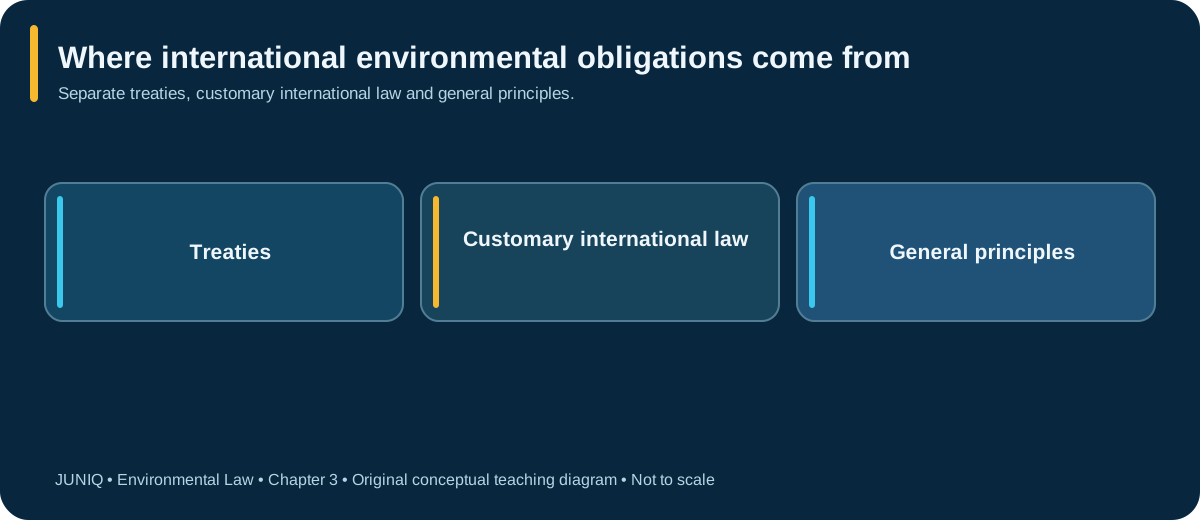
| Source | What it is | Why the distinction matters |
|---|---|---|
| Treaty / convention / protocol | A written international agreement governed by international law. Treaties create binding obligations for parties according to their terms once the relevant consent-to-be-bound requirements are satisfied. | Do not assume the treaty itself is directly enforceable by an Australian citizen. Ask whether and how Australia implemented it domestically. |
| Declaration / soft law | A political or normative instrument that may articulate principles without itself having treaty status. | Soft law can influence legislation, policy and interpretation, but its legal force must not be overstated. |
| Customary international law | A rule developed through sufficiently widespread and consistent State practice accompanied by acceptance that the practice is legally required (opinio juris). | Both elements must be identified. Repeated conduct alone is not enough if States do not treat it as legally obligatory. |
3.5 Customary international law: State practice plus opinio juris
Customary international law requires two related elements: general State practice and acceptance as law, commonly expressed by the Latin term opinio juris. The second element is what distinguishes a legal custom from habit, convenience or diplomatic courtesy.
The Week 3 seminar connects this idea with Pulp Mills on the River Uruguay (Argentina v Uruguay). The International Court of Justice stated that where there is a risk that proposed industrial activity may have a significant adverse transboundary impact, the requirement to undertake an environmental impact assessment can be regarded as a requirement under general international law. The teaching significance is substantial: environmental impact assessment is not merely an Australian planning technique. In an appropriate transboundary context, assessment is part of the international legal architecture for prevention and due diligence.
Facts. Argentina challenged Uruguay's authorisation of pulp mills on a boundary river and alleged breaches of a bilateral river regime and environmental obligations.
Issue. What procedural and substantive environmental obligations applied to a project capable of transboundary effects?
Principle. The Court treated environmental assessment as part of the due-diligence framework where significant transboundary adverse impact is risked. It also distinguished procedural cooperation obligations from substantive environmental obligations.
Why it matters. It teaches students that environmental assessment, notification, cooperation and scientific evidence can have international legal significance before damage occurs.
3B. Sovereignty, due diligence and the no-harm principle
State sovereignty gives a country significant control over resources and activities within its territory. It does not supply an unlimited licence to cause serious transboundary environmental damage. The Trail Smelter arbitration between the United States and Canada (decisions in 1938 and 1941) is traditionally used to teach the no-harm principle: pollution from a Canadian smelter injured interests across the US border, raising responsibility for transboundary damage supported by the necessary evidence. The more exact contemporary argument is that States have due-diligence obligations to prevent significant transboundary environmental harm, and these may involve risk assessment, notification, cooperation and reasonable regulatory measures. The threshold and remedial consequence depend on the applicable source of law and the facts.
The Rio Declaration on Environment and Development (1992), Principle 2, combines sovereign rights to exploit natural resources under environmental and development policies with responsibility to ensure activities within jurisdiction or control do not cause environmental damage to other States or areas beyond national jurisdiction. It is important to distinguish a declaration from a treaty: a declaration may record or influence legal principles, but one should not claim every sentence is independently binding treaty law. Likewise, statements of customary international law require evidence of sufficiently general State practice accompanied by a sense of legal obligation (opinio juris).
The International Court of Justice's decision in Pulp Mills on the River Uruguay (Argentina v Uruguay), Judgment, [2010] ICJ Rep 14, is a useful illustration of transboundary environmental cooperation and due diligence. The Court treated environmental impact assessment as an important requirement when there is a risk that proposed industrial activity may have a significant adverse transboundary effect, while also examining the specific treaty duties in issue. It did not decree one universal EIA form for every country and every project. Use it to connect the source of the duty, threshold of environmental risk, procedural cooperation and evidence—not simply as a slogan that an EIS is always obligatory internationally.
3.6 Sovereignty is the starting point - not the end of the analysis
The seminar describes permanent sovereignty as a foundational idea. A State exercises legal authority over its territory, subject to international law. Sovereignty explains why each State ordinarily controls activities within its jurisdiction. It does not mean that the State may use its territory without regard to the rights of other States or shared environmental systems.
In the marine context, the United Nations Convention on the Law of the Sea (UNCLOS) provides the legal framework students should recognise. The territorial sea may extend up to 12 nautical miles from the applicable baselines. The exclusive economic zone (EEZ) may extend up to 200 nautical miles. The rights in an EEZ are not identical to full territorial sovereignty; they are sovereign rights and jurisdiction for purposes recognised by UNCLOS. Beyond national maritime zones, different high-seas and international regimes apply.
3.7 The no-harm principle and Trail Smelter
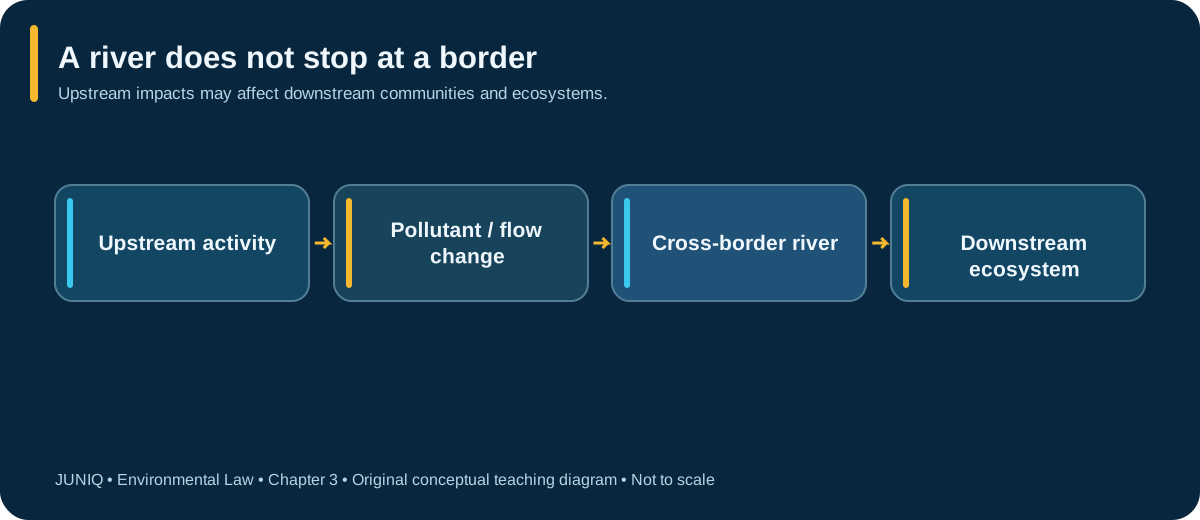
Sovereignty is qualified by responsibility. The classic environmental expression is the no-harm principle: a State should not allow activities within its jurisdiction or control to cause serious environmental injury to another State. The Week 3 seminar explains the idea by analogy with the common-law intuition that a landowner cannot use property in a way that unlawfully harms a neighbour.
Facts. Emissions from a lead and zinc smelter in Trail, British Columbia crossed into Washington State and caused damage.
Issue. Could Canada permit activities in its territory that produced proven cross-border injury in the United States?
Outcome and principle. The arbitral tribunal imposed responsibility in the circumstances and required control of the transboundary pollution. The case became a foundational authority for the proposition that territorial sovereignty is accompanied by obligations regarding serious transboundary harm.
Use it when. A problem involves pollution moving from one State into another, prevention of transboundary harm, State responsibility or the historical development of international environmental law.
3.8 Treaties: signature, ratification and domestic implementation are different steps
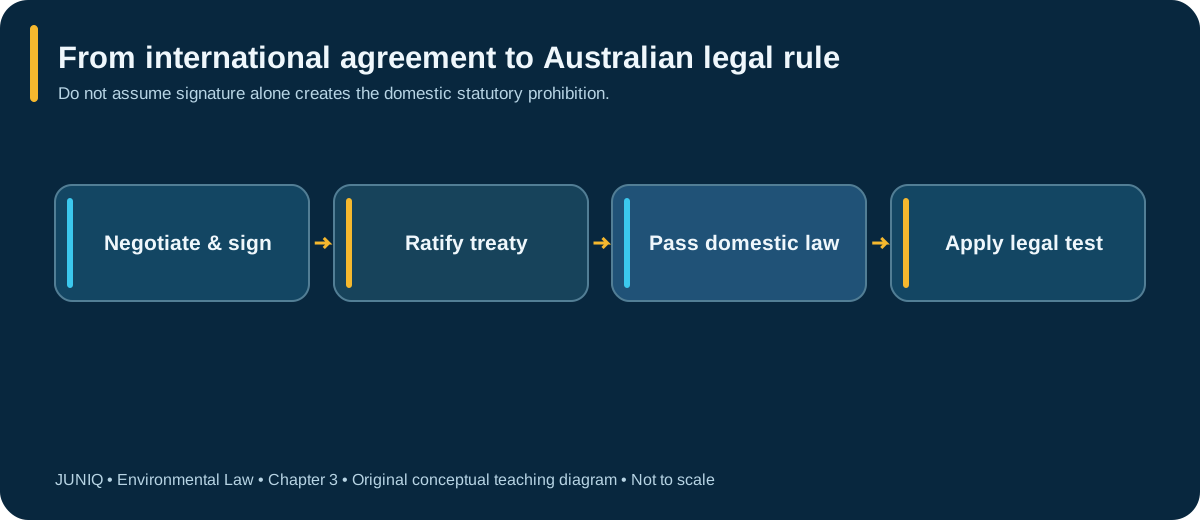
A treaty can be negotiated and signed at the international level, but students must distinguish signature from ratification and both from domestic implementation. The Vienna Convention on the Law of Treaties supplies the general treaty framework, but the central Australian constitutional point for this chapter is simpler: Australian treaties are ordinarily not self-executing. Ratification does not, by itself, rewrite domestic law or create every treaty rule as a directly enforceable cause of action for individuals.
Where domestic legal rights, prohibitions, licences or penalties are required, Parliament generally legislates. For Commonwealth environmental legislation, the constitutional source frequently includes s 51(xxix) of the Constitution - the external affairs power.
3C. How to tell whether a treaty is legally operative in Australia
The lawyer must distinguish adoption, signature, ratification or accession, entry into force and domestic implementation. A country can support an international document politically without the document imposing the same enforceable domestic rule as legislation. In Australia the Executive may enter treaties, but their provisions do not generally become self-executing rights and obligations for Australian persons merely upon ratification. Parliament ordinarily needs to create or amend domestic legislation. The Commonwealth may rely on Constitution s 51(xxix), the external affairs power, to implement relevant treaty obligations, as illustrated by Commonwealth v Tasmania (1983) 158 CLR 1.
The administrative-law caution comes from Minister for Immigration and Ethnic Affairs v Teoh (1995) 183 CLR 273, which examined the relationship between ratification of a treaty and legitimate expectations in administrative decision-making. It is not accurate to state that Teoh makes every unincorporated treaty automatically enforceable as substantive domestic law. Subsequent decisions, government statements and statutory developments require care in applying the principle. The exam-safe method is to identify the treaty, whether the particular obligation has been implemented through an Act, and any legally relevant procedural or interpretive role of international commitments. Distinguish treaty interpretation from a free-standing right to demand that an Australian Minister follow an international policy statement.
An example is World Heritage protection. Australia's international obligations under the 1972 World Heritage Convention explain an important constitutional foundation and policy purpose for Commonwealth legislation. But a proponent's immediate question—'Can we start clearing near this listed property?'—is answered by the EPBC Act's operative World Heritage provisions, referral duties and approval rules. The Convention does not replace those rules. The same discipline applies to wetlands, migratory animals and biological diversity.
3.9 External affairs power: why Commonwealth v Tasmania matters
Section 51(xxix) gives the Commonwealth Parliament power to make laws with respect to external affairs. In environmental law its importance is illustrated by the Tasmanian Dam Case.
Facts. Tasmania sought to proceed with the Gordon-below-Franklin hydro-electric project in an area associated with Australia's World Heritage obligations. Commonwealth legislation sought to prevent conduct affecting the protected property.
Issue. Could the Commonwealth validly legislate to implement Australia's international obligations even though land and resource development were occurring inside a State?
Outcome. The High Court upheld important parts of the Commonwealth scheme. The external affairs power was central to the Commonwealth's capacity to implement Australia's World Heritage Convention obligations.
Why it matters in Chapter 3. It supplies the constitutional bridge between an international environmental commitment and binding Commonwealth domestic legislation.
3.10 Treaties and administrative decision-making: the Teoh caution
The seminar refers to the doctrine associated with Minister for Immigration and Ethnic Affairs v Teoh [1995] HCA 20; (1995) 183 CLR 273. Historically, the High Court held that ratification of a treaty could contribute to a legitimate expectation in administrative decision-making even where the treaty had not been incorporated into domestic law.
Students must not turn that proposition into “ratified treaties are Australian law.” They are not. Nor should Teoh be taught without its later context. In Re Minister for Immigration and Multicultural and Indigenous Affairs; Ex parte Lam [2003] HCA 6; (2003) 214 CLR 1, the High Court's treatment of legitimate expectation substantially limited the utility of that terminology. For environmental advice, the safe method is to identify the domestic statute and the legally mandatory considerations rather than assume an unincorporated treaty is directly enforceable.
3.11 Ozone protection: the international-to-domestic chain in one example
Ozone protection provides a clean illustration of the chapter's method. International concern about ozone depletion produced the Vienna Convention for the Protection of the Ozone Layer and the Montreal Protocol on Substances that Deplete the Ozone Layer. Australia then enacted domestic controls.
The current Ozone Protection and Synthetic Greenhouse Gas Management Act 1989 (Cth) makes the connection explicit. Section 3 states objectives that include giving effect to Australia's obligations under the Vienna Convention and Montreal Protocol, while s 69B identifies the external affairs power and relevant international agreements as part of the Act's constitutional basis.
The international instrument is not decorative background. It explains why the Commonwealth legislates, where constitutional power comes from, and how a global environmental problem becomes a domestic licensing and control regime.
3.12 From sustainable development to ESD: the Brundtland-Rio-Australia pathway
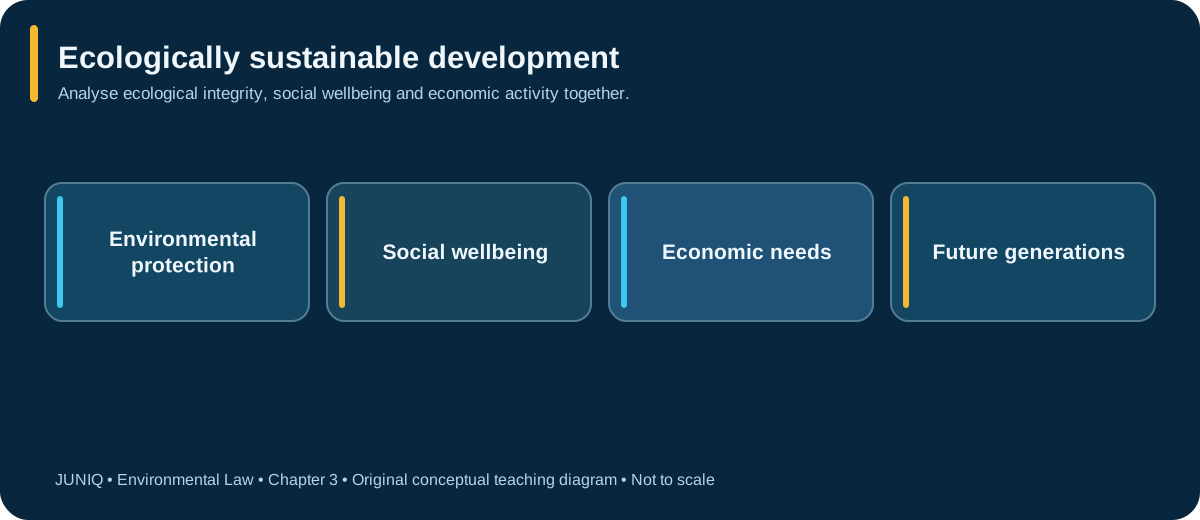
The conceptual origin of modern sustainable-development language is commonly associated with the 1987 World Commission on Environment and Development report, Our Common Future, known as the Brundtland Report. Its enduring idea is development that meets present needs without compromising the ability of future generations to meet their own needs.
The 1992 United Nations Conference on Environment and Development - the Rio Earth Summit - then produced several influential instruments, including the Rio Declaration on Environment and Development, Agenda 21 and the Forest Principles, as well as major treaty developments in climate change and biological diversity.
The Rio Declaration is soft law, not a treaty. Its importance lies in articulating principles that have influenced treaties, domestic legislation, environmental policy and judicial reasoning. Australia developed the domestic expression ecologically sustainable development (ESD), reflected in the 1992 Intergovernmental Agreement on the Environment and subsequently embedded in legislation.
3D. Hard law, soft law and why the Rio process matters
The lecturer traces sustainable development from the World Commission on Environment and Development, Our Common Future (the Brundtland Report, 1987), through the 1992 Rio Earth Summit. Sustainable development is commonly described as development meeting the needs of the present without compromising future generations' ability to meet their needs. That definition is a foundation, not an answer to a specific permit question. Rio produced different forms of international instrument: the Rio Declaration (a declaration articulating principles), Agenda 21 (an action framework), and treaties opened for signature including the Convention on Biological Diversity (CBD) and the United Nations Framework Convention on Climate Change (UNFCCC). Students should be able to distinguish them without treating all as statutes.
In Australian law, ecologically sustainable development (ESD) integrates ecological considerations into development decisions. The EPBC Act's s 3 sets objects; s 3A articulates principles including decision-making processes that integrate long-term and short-term economic, environmental, social and equitable considerations; the precautionary principle; intergenerational equity; biodiversity and ecological integrity; and improved valuation, pricing and incentive mechanisms. Later, s 136 identifies factors the Minister must take into account at an approval decision, while s 391 connects particular decisions to the precautionary principle. The critical distinction is between a broad principle and the statutory step at which Parliament requires it to be considered.
Students sometimes say 'ESD means the Minister must choose the environmentally best project.' That is too simple. ESD involves integration of different legally recognised considerations within the particular statute. Some statutory provisions impose hard restrictions; others require an exercise of judgment. A court reviewing an approval will examine compliance with the actual legal requirements, not substitute a free-ranging personal preference for the Minister's lawful discretion.
3.13 EPBC Act ss 3, 3A and 136: turning ESD into operative legal reasoning
The current Environment Protection and Biodiversity Conservation Act 1999 (Cth) does more than mention sustainability. Section 3 includes promotion of ecologically sustainable development among the Act's objects. Section 3A identifies five ESD principles:
- integration of long-term and short-term economic, environmental, social and equitable considerations;
- the precautionary principle;
- intergenerational equity;
- conservation of biological diversity and ecological integrity as a fundamental consideration; and
- improved valuation, pricing and incentive mechanisms.
The distinction between an object and an operative decision rule matters. Section 136(1) sets mandatory considerations for approval decisions, including matters relevant to controlling provisions and economic and social matters. Under s 136(2)(a), the Minister must take into account the principles of ESD when considering those matters.
3.14 The precautionary principle: uncertainty is part of the legal problem
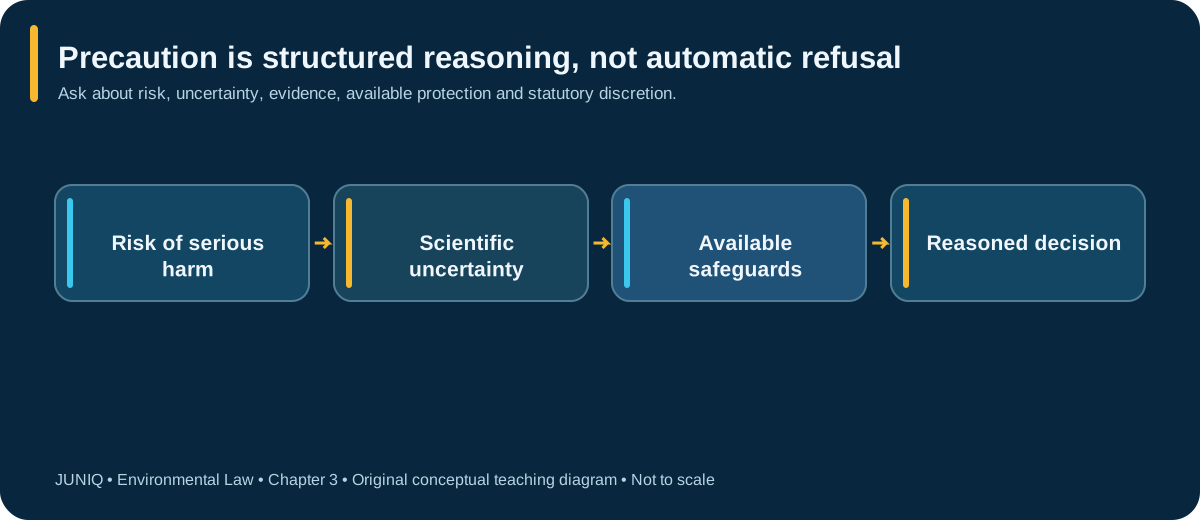
Section 3A(b) expresses the precautionary principle: where there are threats of serious or irreversible environmental damage, lack of full scientific certainty should not be used as a reason for postponing measures to prevent environmental degradation.
The principle is often misunderstood. It does not mean “ban anything uncertain.” Nor does it mean “science is irrelevant.” It means that serious environmental risk cannot be ignored merely because the evidence is incomplete. The legal decision-maker should identify the threat, assess the uncertainty, evaluate the consequences of being wrong and adopt proportionate preventative measures where the legal framework requires it.
Facts. Shoalhaven City Council proposed a link road. A licence had been granted under State fauna-protection legislation. The evidence concerning the giant burrowing frog was incomplete: the area was not treated as prime habitat and the species had not been directly observed on the project site, but evidence indicated a male call had been heard and the species could travel significant distances.
Issue. How should a decision-maker respond when the possible impact on a threatened species is serious but the scientific evidence is uncertain?
Reasoning. Stein J treated precaution as a common-sense decision principle suited to uncertainty about species population, habitat and behaviour. Lack of complete knowledge did not justify assuming the risk away.
Outcome. The licence was not granted on the material then available, while leaving open the possibility that better scientific knowledge could support a different decision later.
Why it matters. Leatch teaches the difference between prevention, where harm is sufficiently known, and precaution, where uncertainty itself is legally relevant because the possible harm is serious or irreversible.
3E. Precaution: uncertainty is a reason to investigate, not an excuse to guess
The precautionary principle in EPBC Act s 3A(b) concerns threats of serious or irreversible environmental damage and the role of lack of full scientific certainty. A similar principle appears in the Rio Declaration, Principle 15. The Australian judicial explanation frequently taught through Leatch v National Parks and Wildlife Service (1993) 81 LGERA 270; [1993] NSWLEC 191, involving a proposed road and habitat of the giant burrowing frog, shows that precaution can be practically important when information is incomplete and consequences may be grave. The case must be used within its own legal and evidentiary setting rather than treated as a universal ban on any project involving an endangered species.
Teach the reasoning in stages. First, identify the environmental value and the feared damage: extinction risk, irreversible habitat loss, contamination or disruption to breeding. Secondly, explain what evidence exists and what remains uncertain: surveys, expert opinion, modelling or studies from a different species. Thirdly, evaluate the seriousness and possible irreversibility of the harm. Fourthly, identify the statutory decision and whether precaution is mandatory or discretionary in that context. Fifthly, examine practical responses: additional surveys, project redesign, buffers, staging, monitoring, adaptive conditions or refusal where legally justified. The principle neither proves that damage will happen nor permits the decision-maker to ignore serious plausible risks because absolute certainty is unavailable.
The Week 5 Oxleyan Pygmy Perch hypothetical illustrates the point beautifully. The Council proposes relocating fish before damming a shallow creek that supports breeding. A European relocation of a different pygmy-perch species is mentioned, but the long-term outcome is unknown. That evidence does not establish that relocating the particular Australian population will succeed. The lawyer should identify whether the actual species is nationally listed, whether the predicted impact is significant, what scientific uncertainty remains, and why the Minister must take the applicable precautionary provision into account. Do not confuse a duty to consider precaution with an automatic duty to refuse approval; the adequacy of the reasoning and evidence is central.
3.15 How to apply precaution step by step
3.16 Intergenerational equity: decisions are not confined to today's impacts
Section 3A(c) describes intergenerational equity: the present generation should ensure that the health, diversity and productivity of the environment are maintained or enhanced for future generations. This principle expands the decision horizon. A project may produce immediate benefits while transferring environmental costs to people who cannot participate in today's decision.
Facts. Peter Gray challenged aspects of the environmental assessment process for the proposed Anvil Hill open-cut coal mine in New South Wales. The greenhouse analysis addressed direct mine emissions but did not adequately account for downstream emissions from burning the coal.
Issue. Could assessment stop at emissions physically produced at the mine gate?
Reasoning. The Court treated ESD, including intergenerational equity, as relevant to the statutory assessment process and required a broader understanding of environmental consequences.
Why it matters. Students learn to ask about indirect, downstream and cumulative impacts, not merely immediate site disturbance. A complete environmental assessment can require attention to consequences occurring later or elsewhere.
3F. Intergenerational equity and cumulative environmental effects
Intergenerational equity requires lawyers to think beyond immediate construction and revenue. A project may operate for decades; habitat or groundwater recovery may take longer still. A mine assessment limited to the first year of site operations may fail to communicate its true environmental consequences. The Week 4 slides introduce Gray v Minister for Planning [2006] NSWLEC 720. The proposed Anvil Hill coal mine was assessed in a setting where the environmental assessment had considered direct greenhouse-gas emissions but not downstream emissions from burning the exported coal. The NSW Land and Environment Court connected the statutory objects, ESD and the requirement for an adequate assessment, including cumulative impacts. The decision's legal operation was specific to NSW planning law; its broader teaching value is that the environmental information relevant to a decision may extend beyond the obvious on-site activity.
Notice the method shared by Gray, Mon Repos, Nathan Dam and modern EIA: identify the causal pathway and the statutory rule that makes it legally relevant. For a dam, water extraction may enable downstream irrigation and diffuse pollution. For a mine, coal may be burnt elsewhere. For a resort, supporting roads and waterworks may be undertaken by other proponents. These are not identical statutory questions, and direct and indirect impacts must still satisfy the applicable statutory definition. The connecting discipline is to avoid selecting an arbitrary narrow boundary around the project simply because it makes the assessment easier.
Taralga Landscape Guardians Inc v Minister for Planning [2007] NSWLEC 59 provides a balancing illustration from wind-energy development. Environmental, social, landscape and energy benefits can point in different directions. A responsible ESD analysis evaluates their actual legal relevance and the evidence; it does not reduce every renewable-energy proposal to an automatic approval or every ecological concern to an automatic refusal. This matters because sustainable development is an evaluative process, not a predetermined slogan.
3.17 ESD does not always operate against development: Taralga
Environmental principles do not mechanically select one side. A renewable-energy project may itself advance long-term environmental objectives while causing local amenity, landscape or ecological impacts. The lawyer must therefore identify the statutory criteria and weigh the evidence rather than label one party “pro-environment”.
Teaching point. The Land and Environment Court considered objections to a wind farm and the broader environmental benefits of renewable energy. The case demonstrates that ESD principles can support a project where its long-term environmental benefits form part of the statutory balance.
Exam use. Use Taralga to resist the simplistic proposition that ESD always means refusing development. ESD is a disciplined framework for integrated decision-making.
3.18 Climate change: from framework convention to domestic law
Climate change illustrates layered international regulation. The United Nations Framework Convention on Climate Change (UNFCCC) establishes the foundational framework and recognises differentiated responsibilities and capabilities. The Kyoto Protocol developed quantified and market-based mechanisms for participating developed-country parties, while the Paris Agreement establishes a global framework based on nationally determined contributions, progression and review.
Students should distinguish a framework convention from later protocols or agreements. The convention establishes the institutional and legal architecture; later instruments can add or refine commitments.
3.19 Australian climate legislation: targets are not the same thing as reporting
The Climate Change Act 2022 (Cth) sets national emissions-reduction targets. Section 10(1) identifies a target of reducing net greenhouse gas emissions to 43% below 2005 levels by 2030 and to net zero by 2050.
That legislation must be distinguished from the National Greenhouse and Energy Reporting Act 2007 (Cth), which establishes a reporting framework for greenhouse gas emissions, energy production and energy consumption and supports administration of related regulatory mechanisms. One statute contains national targets; the other creates reporting and data obligations. Conflating them produces bad legal advice.
3.20 Climate adaptation in planning: today's approval can create tomorrow's hazard
Climate law is not only about reducing emissions. Planning and development law also deals with adaptation: flooding, sea-level rise, coastal erosion, heat, bushfire and infrastructure resilience. The seminar's coastal subdivision example asks whether land should be approved for development where modelling indicates serious future inundation and loss of access.
The legal technique is familiar: identify the planning statute and scheme, identify the relevant hazard policy or assessment requirement, obtain technically competent evidence, and determine whether the proposal is acceptable over the planning horizon. Precaution and intergenerational equity can explain why a decision-maker should not ignore a foreseeable future hazard merely because it may occur beyond the present owner's lifetime.
3H. Ozone, climate and transboundary pollution: three different problems
The Vienna Convention for the Protection of the Ozone Layer (1985) and the Montreal Protocol on Substances that Deplete the Ozone Layer (1987) form the background to Australia's ozone protection regime, implemented through legislation including the Ozone Protection and Synthetic Greenhouse Gas Management Act 1989 (Cth). Their regulatory design is comparatively concrete: controls on specified substances, importation, manufacture and related reporting or licensing. If a problem mentions a regulated substance, the lawyer should identify the current schedule, authorisation and prohibition; do not assume a broad international duty itself supplies an offence for a private importer.
Climate agreements pursue a related but distinct global problem. The UNFCCC (1992) established a framework for international climate cooperation; the Paris Agreement (2015) uses nationally determined contributions and processes for transparency and progression. In Australia the Climate Change Act 2022 (Cth) provides statutory targets and reporting-related architecture, while other enactments deal with emissions reporting and safeguards. A legally accurate answer separates international commitments from domestic targets, sector-specific controls and a particular project's approval requirements. It should also distinguish mitigation (reducing emissions and enhancing sinks) from adaptation (responding to unavoidable climate effects).
Marine pollution provides another example of treaty-to-statute implementation. Shipping operations and sea dumping may be governed by particular Commonwealth Acts and regulations rather than the general EPBC development referral alone. Start by identifying whether the problem concerns a vessel discharge, deliberate disposal at sea, protected marine-area impact or a pollution incident; these invoke different regimes. The Week 3 teaching is not that one international convention governs every ocean problem, but that lawyers must find the correct layer of international obligation, domestic enactment and enforcement body.
3.21 Marine pollution: international liability translated into domestic statutes
Marine oil pollution requires rapid response. International conventions allocate liability and support compensation mechanisms so that clean-up need not wait for final resolution of every fault dispute. Australian law gives effect to that architecture through several statutes rather than one generic “oil pollution Act”.
Two central Commonwealth statutes students should recognise are the Protection of the Sea (Civil Liability) Act 1981 (Cth) and the Protection of the Sea (Oil Pollution Compensation Funds) Act 1993 (Cth). Sea dumping is separately addressed through the Environment Protection (Sea Dumping) Act 1981 (Cth).
The teaching lesson is structural: identify the source of marine pollution, identify the relevant international convention, then identify the Australian implementing statute. Liability for oil carried by tankers, pollution from ships, dumping of waste at sea and emergency response do not necessarily sit in the same Act.
3.22 Biological diversity: more than counting species
The Convention on Biological Diversity (CBD) defines biological diversity broadly to include variability among living organisms and diversity within species, between species and of ecosystems. Article 1 identifies three objectives: conservation of biological diversity, sustainable use of its components, and fair and equitable sharing of benefits arising from genetic resources.
This breadth matters because environmental law is not simply a list of charismatic animals. Habitat, ecological processes, genetic variation and ecosystem relationships can be legally and scientifically important. A species may appear locally abundant yet depend on a threatened habitat, breeding area, food source or migration route.
The seminar identifies recurring causes of biodiversity loss including habitat destruction, over-exploitation, invasive species and climate change. It also emphasises two reasons biodiversity regulation is difficult: extinction and habitat loss can be irreversible, and human knowledge of ecological relationships is incomplete.
3.23 Biosphere 2 as a teaching analogy: why ecological humility matters
The seminar uses the Biosphere 2 experiment as an analogy for ecological uncertainty. The deeper lesson is not the precise number of species or engineering details; it is that humans can misjudge which ecological interactions are necessary to maintain a functioning system. Environmental decision-making therefore requires humility about incomplete knowledge.
This links directly back to precaution. If a development would remove the only known breeding habitat of a threatened species, the absence of complete knowledge about the species' ecological role does not logically prove that its loss is harmless. The legal task is to apply the governing statute and evidence without pretending that uncertainty equals safety.
3.24 International biodiversity instruments become specific domestic hooks
The CBD is broad, but biodiversity law also includes instruments directed to particular sites, habitats, species and forms of trade. Students should recognise the architecture:
| International instrument | Environmental focus | Australian legal connection to investigate |
|---|---|---|
| World Heritage Convention | Cultural and natural heritage of outstanding universal value | EPBC Act World Heritage provisions and constitutional external-affairs basis. |
| Ramsar Convention | Wetlands of international importance | EPBC Act protection of declared Ramsar wetlands. |
| Convention on Migratory Species (Bonn Convention) and relevant bilateral migratory-bird agreements | Migratory wildlife crossing national boundaries | EPBC Act listed migratory species provisions. |
| CITES | International trade in endangered species | EPBC Act wildlife-trade controls and permits. |
| International Convention for the Regulation of Whaling 1946 | Conservation and regulation of whaling | International Whaling Commission regime; Australian cetacean protection under the EPBC Act. |
3G. Biodiversity treaties: identify the exact species, place and legal mechanism
The Convention on Biological Diversity (1992) sets an international framework for conservation of biological diversity, sustainable use of its components, and fair and equitable sharing of benefits arising from genetic resources. Article 8 deals with in-situ conservation, including protected areas and conservation of ecosystems and natural habitats. That helps explain Australian conservation design, but the direct domestic question is usually answered through an EPBC listing and the relevant Part 3 trigger. The Convention on International Trade in Endangered Species of Wild Fauna and Flora (CITES) concerns international trade in specified species and specimens; it should not be confused with a general domestic ban on all development affecting any species.
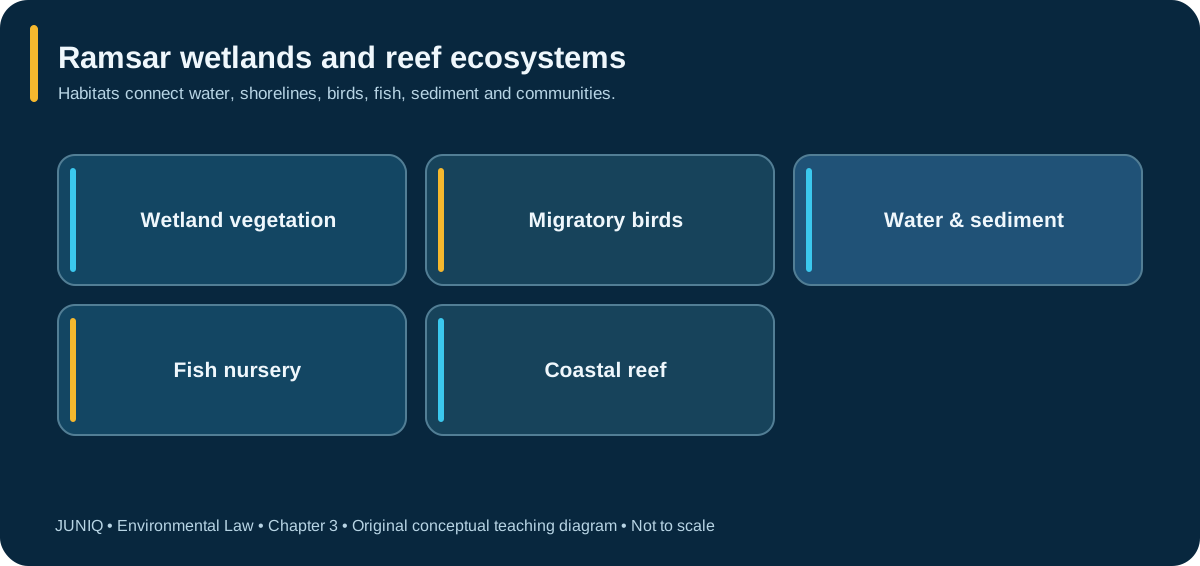
The Convention on Wetlands of International Importance especially as Waterfowl Habitat (Ramsar, 1971) is foundational to the international wetlands protection regime. Wetlands such as Moreton Bay may support migratory shorebirds, so a project may engage overlapping Ramsar and listed-migratory-species provisions. The Bonn Convention, together with the bilateral migratory bird agreements with Japan, China and the Republic of Korea (commonly JAMBA, CAMBA and ROKAMBA), illustrates why wildlife migration raises international obligations. Do not assume one site's protection depends exclusively on the presence of an endangered species; the ecological character of a Ramsar wetland is its own protected matter.
In tutorial answers, construct a table in your mind: protected matter → underlying treaty (if any) → domestic controlling provision → required factual impact. National Heritage is not underpinned by a matching international convention in the same direct way as World Heritage; its inclusion relies on different constitutional structures. Likewise, nuclear actions and the water-resource trigger cannot simply be attributed to a single international environmental treaty. The Week 4 tutorial focuses on exactly this distinction.
3.25 Whaling: one problem, two legal pathways
The whaling material is a powerful synthesis because it shows the same environmental conduct being examined through both Australian domestic law and public international law.
Under the International Convention for the Regulation of Whaling (ICRW), the International Whaling Commission adopted a commercial whaling moratorium. Article VIII permits a contracting government to issue special permits authorising its nationals to kill, take and treat whales for purposes of scientific research. Japan relied on the special-permit mechanism for its Antarctic research programmes, including JARPA II.
The legal issue was not simply whether a permit had the word “scientific” on it. It was whether the programme was genuinely within the treaty exception when assessed against its design and implementation.
3.26 Antarctica: sovereignty claims are legally sensitive
Australia claims sovereignty over the Australian Antarctic Territory, but Antarctic sovereignty is internationally complex and is not universally recognised. The Antarctic Treaty preserves the positions of claimant and non-claimant States through Article IV while enabling peaceful use, scientific cooperation and a stable legal framework without requiring final resolution of territorial claims.
3.27 The Australian Whale Sanctuary: start with EPBC Act s 225
Part 13 of the EPBC Act contains Commonwealth cetacean protections. Section 225 establishes the Australian Whale Sanctuary. The statutory definition and application must be read carefully rather than reduced to the shorthand “3 nautical miles to 200 nautical miles”. Sections 229 and 230 form part of the offence/civil-penalty regime concerning killing or injuring cetaceans in the Sanctuary, subject to statutory exceptions and permits.
Inside Queensland coastal waters, separate State wildlife rules may also apply. The current Nature Conservation (Animals) Regulation 2020 (Qld) contains whale and dolphin approach rules, including no-approach and caution zones. Again, the professional lesson is layered regulation rather than a single universal rule.
3.28 Humane Society International v Kyodo Senpaku Kaisha: domestic enforcement
Humane Society International (HSI), an environmental organisation, sought to use Australian domestic law against a Japanese whaling company operating in waters Australia treated as part of the Australian Whale Sanctuary adjacent to the Australian Antarctic Territory. The litigation raised difficult questions of extraterritorial service, international relations, enforceability and the proper role of a domestic court.
First instance. Allsop J refused leave to serve the proceeding outside Australia. The international and diplomatic setting, including the practical enforceability of any injunction, formed part of the context.
Appeal. The Full Federal Court allowed HSI's appeal. The judicial task of applying Australian law could not simply be displaced by executive concerns about diplomatic consequences. The case returned for further steps, including substituted service.
Injunction. The Federal Court ultimately granted declaratory and injunctive relief restraining the company from conduct contrary to the EPBC Act in the Sanctuary. Enforcement remained practically difficult while the company and vessels remained outside ordinary Australian enforcement reach.
Teaching significance. A legal right and a practical remedy are not the same thing. Jurisdiction, service, enforcement assets and diplomatic context all matter after the substantive environmental prohibition has been identified.
3I. Whaling: distinguish the Australian litigation from the international case
The course's whale litigation is a powerful demonstration of two legal systems addressing a related controversy. In Humane Society International Inc v Kyodo Senpaku Kaisha Ltd, the Federal Court dealt with Japanese whaling activities in the Australian Whale Sanctuary and the operation of Australian domestic legislation. The applicable statutory setting includes the EPBC Act's cetacean provisions and the sanctuary established under s 225. The proceedings also illustrate standing, jurisdiction, remedies and the practical difficulty of enforcing a judgment against a foreign operator. Students should identify precisely which of the related reported decisions they rely upon; the preliminary and final judgments are not interchangeable.
At the international level, Whaling in the Antarctic (Australia v Japan: New Zealand intervening), Judgment, [2014] ICJ Rep 226, examined Japan's programme under the International Convention for the Regulation of Whaling. The International Court of Justice assessed whether the special-permit programme was within the treaty's research exception, considering the design and implementation of the programme. The Court's judgment concerned treaty compliance between States. The Federal Court proceedings concerned enforceable Australian domestic statutory duties. The common controversy should not obscure the different jurisdiction, parties, tests and remedies.
When asked for advice about cetacean protection, identify species and location, whether the Australian Whale Sanctuary is involved, the conduct at issue, the EPBC provisions and available remedies. Do not begin with the ICJ judgment merely because it is the best-known whaling case if the real question is domestic approval or enforcement.
3.29 The same controversy at international law: Whaling in the Antarctic
Issue. Was Japan's JARPA II programme genuinely “for purposes of scientific research” within Article VIII of the ICRW?
Outcome. The International Court of Justice concluded that the special permits granted in connection with JARPA II did not fall within Article VIII in the relevant respects and required Japan to revoke existing permits and refrain from granting further permits under that programme.
Why it matters. Compare this with the HSI litigation. The Federal Court proceedings concerned enforcement of Australian domestic legislation against a company. The ICJ proceeding was a State-to-State international law case brought by Australia against Japan, with New Zealand intervening. Same environmental controversy; different parties, sources of law, forums and remedies.
3.30 Bringing the whole chapter together: the international-to-domestic map
A student who remembers only a list of treaties has missed the chapter. The objective is to understand legal transmission: how an environmental problem becomes an international commitment, how that commitment can support Australian legislation, how the legislation creates concrete prohibitions or decision criteria, and how a lawyer applies those rules to a project or dispute.
3.31 Practitioner issue-spotting checklist
- Define the environmental harm. Pollution, habitat loss, greenhouse emissions, marine spill, species impact or cumulative harm?
- Locate the geography. One State, multiple States, another country, territorial sea, EEZ, Antarctic waters or global commons?
- Identify the actors. Private company, individual, Commonwealth, State, foreign State, regulator or NGO?
- Classify the source. Treaty, soft law, custom, Constitution, Commonwealth Act, State Act, regulation or case?
- Explain legal force. Is the treaty implemented domestically? What constitutional power supports the Act?
- Find the exact operative law. Section, subsection, paragraph, article, definition, exception and permit power.
- Match the authority. What case explains the provision or principle and what does it actually establish?
- Test evidence and uncertainty. What is known? What is modelled? What is missing? What expert work is required?
- Apply counterarguments. Is the impact serious, indirect, reversible, mitigable, uncertain, socially necessary or outweighed by another statutory objective?
- Advise the next lawful step. Assess, refer, obtain permit, redesign, condition, monitor, challenge, seek injunction or negotiate.
EXTENDED TEACHING — COMPLETE FACT-TO-LAW APPLICATION
These additional classroom explanations connect the legislation, the authorities and their practical use. Blue hyperlinks open the cited source documents.
3K. WHEN A RIVER CROSSES A BORDER, WHOSE LAW APPLIES?
The Week 3 cyanide-spill case study is a particularly effective way to understand international environmental law because the pollution followed the water rather than political borders. The Aurul/Esmeralda joint venture in Romania used cyanide in gold recovery and stored waste in a tailings system. Following the escape of contaminated water, downstream communities and ecosystems in Hungary were affected. The classroom question is not simply whether the event was harmful. It is which court could hear a claim, which law would apply, what duty would be pleaded, how causation and damage would be proved, and whether a judgment obtained in one country could be enforced against assets in another.
There are two branches of analysis. Private international law deals with cross-border private claims and conflicts of laws. An affected landowner or business might attempt a civil action for a recognised tort, depending on jurisdictional and choice-of-law rules. That claim requires actionable damage, a legal duty or cause of action, proof of factual and legal causation and enforceable relief; the global importance of clean rivers does not remove those elements. Public international law concerns duties between States, treaty obligations and customary principles. The classic Trail Smelter arbitration concerned industrial fumes from Canada damaging interests in the United States. It is often cited for the principle that one State must not permit activities under its jurisdiction to cause serious transboundary harm to another, but students should read its factual and legal setting and not pretend that every allegation of cross-border pollution automatically generates a private damages remedy.
Pulp Mills on the River Uruguay (Argentina v Uruguay) illustrates the procedural/substantive distinction. The International Court of Justice examined a bilateral river regime and found procedural breaches relating to notification and cooperation, while the evidence did not establish every asserted substantive environmental injury. This distinction is crucial. A State may breach an obligation to notify, consult or assess without it being proved that the entire project caused the pollution claimed by the opposing State. Conversely, compliance with procedure does not necessarily excuse substantive environmental harm.
For a hypothetical pollution claim, give structured advice. Identify the legal persons (State and private operator), the pollution route, the relevant treaty or domestic statute, the decision process that should have preceded the activity, expert sampling and source apportionment evidence, and the available forum. Then consider prospective prevention, injunction or interim measures, monitoring and potential compensation according to the actual jurisdiction. Only after those checks can a lawyer responsibly state prospects of success. The essential lesson is that an international environmental principle supplies a standard of conduct, but it does not automatically determine private standing, jurisdiction or a particular remedy.
3L. TREATY, DOMESTIC STATUTE AND ADMINISTRATIVE DECISION ARE THREE DIFFERENT STEPS
The Week 3 seminar asks students to trace connections between the nine EPBC protected matters and treaties Australia has ratified. That is an exercise in legal architecture. A treaty can create obligations between States under international law. Australia's Constitution s 51(xxix) may provide power to enact domestic implementing legislation. The EPBC Act, once enacted, imposes the domestic tests on proponents and decision-makers. The fact that a document is called a convention does not, by itself, give a private citizen a directly enforceable domestic cause of action. The adviser must identify the domestic provision that applies.
World Heritage protection provides a particularly clear chain. The World Heritage Convention recognises natural and cultural heritage of outstanding universal value; the Tasmanian Dam Case confirms the potential constitutional foundation for Commonwealth implementation; EPBC Act ss 12–15A give domestic force to relevant protections. But World Heritage and National Heritage are not interchangeable. The latter has its own statutory framework in ss 15B–15C, reflecting differently drafted constitutional reach. The Ramsar Convention concerns wetlands of international importance; the EPBC Act's Ramsar provisions regulate significant effects on those wetlands. The Convention on Biological Diversity supplies international conservation obligations, including in-situ conservation (art 8), while domestic protection of a listed species depends upon its national legal status and the applicable EPBC trigger. The Bonn Convention (CMS) and bilateral migratory-bird agreements connect to listed migratory species. These links matter because students must understand why Parliament protected the matter and how the relevant provision is drafted.
Do not treat soft-law declarations as if they were treaties creating identical obligations. The Rio Declaration expresses influential principles, including no-harm and precautionary thinking, but its status differs from a ratified treaty and from a binding Australian statute. The 1987 Brundtland Report developed the language of sustainable development; the 1992 Rio Earth Summit advanced global environmental cooperation and produced the Rio Declaration and major conventions. These sources explain policy and interpretation, but the operative legal consequence in an EPBC approval still arises under the Act, including ss 3A, 136 and 391, as applicable.
The administrative-law connection also matters. In Minister for Immigration and Ethnic Affairs v Teoh, a ratified treaty informed a legitimate-expectation debate; Ex parte Lam later emphasised practical injustice in procedural fairness analysis. Neither case authorises the simple claim that a treaty guarantees an environmental approval outcome. If advising a community group, identify what procedural obligation was imposed, how the decision-maker allegedly failed to comply, whether the plaintiff has standing, and whether the defect could justify reconsideration. That is more sophisticated than reciting a treaty title in an answer.
3M. HOW ESD AND PRECAUTION WORK IN A REAL DEVELOPMENT ASSESSMENT
Ecologically sustainable development (ESD) is often reduced to a slogan. In practice it involves integrating environmental, social and economic considerations, attending to long-term effects and future generations, protecting biodiversity and taking environmental costs seriously. Different statutes incorporate those ideas in different ways. In Leatch v National Parks and Wildlife Service, the NSW Land and Environment Court examined a proposed road through habitat associated with the giant burrowing frog and applied the precautionary principle in the statutory setting. The principle is not an automatic veto whenever science is uncertain. It becomes especially important where there is a threat of serious or irreversible environmental harm combined with scientific uncertainty, requiring a careful evidentiary and risk-management response. The lawyer should identify what is uncertain, how serious the harm may be, and whether alternatives, mitigation or refusal are justified within the applicable power.
Gray v Minister for Planning is a powerful case because it exposes what an apparently detailed environmental assessment may still overlook. The proposed Anvil Hill coal mine would generate direct emissions at the mine and downstream emissions when exported or supplied coal was burnt elsewhere. The NSW assessment failed to address that consequential component as required in the legal context. The Court treated ESD and intergenerational equity as relevant to the assessment exercise and found a legal flaw. It did not announce that all coal projects are forbidden. The reasoning teaches students to distinguish the completeness and legality of an assessment process from the substantive merit of the final approval. An environmental assessment may need to include indirect or cumulative effects without predetermining how the eventual decision-maker will weigh them.
Take a hypothetical wind farm affecting birds and generating low-emissions electricity. One side emphasises collision risk, habitat loss and visual effects; the other emphasises climate benefits and community demand. Taralga Landscape Guardians provides a useful illustration of how ESD does not eliminate the need to balance different statutory objectives and evidence. The important question is what the relevant statute directs the decision-maker to consider. The lawyer should obtain an avifauna study, assess alternatives and cumulative effects, examine net emissions assumptions, and propose measurable conditions where the statute allows them. A legally persuasive conclusion does not say simply 'green energy wins' or 'birds win'; it identifies relevant findings and the consequences of choosing one course over another.
For exam writing I use a disciplined sentence structure: 'The risk is [specific harm]. The legal source is [statute/provision]. The authority [case] explains [the interpretive point]. On these facts, [scientific evidence] tends to establish [element], whereas [counterevidence] supports [counterargument]. The decision-maker must therefore [legally required next step]. If the requirement is ignored, [appropriate review or enforcement consequence] may follow.' This makes environmental principles operational rather than decorative.
CASES AND AUTHORITIES: FACTS, REASONING AND APPLICATION
Trail Smelter Arbitration (United States v Canada), 3 RIAA 1905
THE FACTS. Industrial emissions from a Canadian smelter caused damage across the border in the United States. The dispute was handled through an international arbitral mechanism.
THE PRINCIPLE. The award is a classic statement of State responsibility for serious transboundary harm where the necessary evidence and standard are met. It is not a modern private tort judgment giving every affected individual a direct claim against any foreign company.
APPLICATION. An Australian-law answer should separate the international State-to-State obligation from questions of which domestic court has jurisdiction, what domestic substantive law applies, and whether any damages judgment can be enforced. In the Week 3 Baia Mare cyanide spill example, evidence of cause, location of conduct, location of harm and the parties' status are as important as the broad no-harm principle.
Pulp Mills on the River Uruguay (Argentina v Uruguay), ICJ Reports 2010
THE DISPUTE. Uruguay authorised pulp-mill development along a shared river. Argentina objected, alleging breach of procedural and environmental duties under the parties' governing river arrangements.
THE ICJ'S TEACHING. The Court treated environmental impact assessment as an important requirement in the setting of potentially significant transboundary harm and considered the treaty's information and notification framework. It distinguished procedural breaches from proof of substantive environmental harm: establishing an inadequate notification process does not itself prove all damage alleged.
APPLICATION. Identify the applicable treaty, the possibility of significant transboundary effects, the duty to cooperate/notify, the scientific assessment and the remedy sought. Do not assert that an ICJ ruling automatically creates a private cause of action under the EPBC Act.
Minister for Immigration and Ethnic Affairs v Teoh (1995) 183 CLR 273
THE FACTS AND DOCTRINE. A migration decision engaged questions about Australia's ratification of the Convention on the Rights of the Child and the treatment of affected children. The High Court considered how ratification might influence administrative-law expectations in the circumstances of the case.
WHY IT IS TAUGHT IN ENVIRONMENTAL LAW. Australia entering a treaty is not identical to Parliament giving it full domestic operation. Teoh is a teaching point about the relationship between international commitments, executive administration and Australian law; the doctrine subsequently developed and must not be recited as an automatic remedy.
APPLICATION. When discussing the CBD, Ramsar or climate commitments, find the actual implementing statute and relevant statutory provision before attributing legal obligations to a project proponent.
Re Minister for Immigration and Multicultural Affairs; Ex parte Lam (2003) 214 CLR 1
THE LEGAL CONNECTION. Lam emphasises the need to examine practical procedural unfairness rather than treating an abstract 'legitimate expectation' as automatic invalidity. It is often read alongside Teoh to show how Australian administrative law evaluates the real fairness of a decision-making process.
APPLICATION. For environmental consultation or ministerial approvals, ask what process was promised or legally required, what actually happened, whether the complainant lost a fair opportunity to address an adverse issue, and what material consequences follow. A disputed public consultation does not guarantee relief without identifying the legal rule and material prejudice.
Leatch v National Parks and Wildlife Service [1993] NSWLEC 191
THE FACTS. A road proposal raised concern about the giant burrowing frog and sensitive habitat. Scientific uncertainty surrounded serious possible harm and the adequacy of the proposal's investigation.
THE DECISION AND TEACHING. The Court's treatment of precaution demonstrates that uncertainty can strengthen the case for careful investigation and protective decision-making where serious or irreversible harm is plausible. Precaution is not the same thing as proof that development must always be refused.
LEGISLATION AND LIMITS. The case arose under its own NSW statutory context. For a present Commonwealth EPBC decision, use s 391 (the precautionary principle where applicable) and the mandatory considerations in s 136, rather than relying on Leatch as a free-standing veto.
APPLICATION. Identify the particular threatened population, specialist evidence, uncertainties, alternative route or design, monitoring possibility, and who bears the legal obligation to address those matters.
Gray v Minister for Planning [2006] NSWLEC 720
THE FACTS. The Anvil Hill coal-mine environmental assessment assessed emissions from mine operations but omitted greenhouse gas emissions arising when purchasers burned the extracted coal at power stations.
THE HOLDING. The NSW Land and Environment Court found that the decision-maker had not lawfully addressed the assessment's scope and relevant ESD principles, including cumulative and intergenerational consequences, in the statutory setting. The adequacy decision was declared void. The case turns on the actual NSW assessment requirements and their purpose.
WHY IT MATTERS. An assessment should not be artificially narrowed simply because an important environmental effect arises after a product leaves the site. But the case is not a universal holding that every future indirect effect is legally attributable under every Act.
APPLICATION. In an exam, name the coal, its foreseeable use, the greenhouse consequence and the governing NSW planning provisions; then distinguish those provisions from EPBC Act s 527E and Nathan Dam when dealing with Commonwealth indirect impacts.
Taralga Landscape Guardians Inc v Minister for Planning [2007] NSWLEC 59
THE CONTEXT. A proposed wind farm raised complex arguments about landscape, amenity, energy policy and the public interest. The NSW Court had to reason through competing environmental and community values within the governing planning law.
THE TEACHING POINT. Environmental adjudication often involves more than comparing 'development versus trees'. Renewable-energy benefits and local environmental or amenity impacts may both be legitimate considerations; the legal issue is how the applicable statute directs them to be weighed.
APPLICATION. Identify the particular decision-maker and statutory factors, distinguish mandatory from discretionary considerations, and show why both proponents' and opponents' evidence deserves attention. Taralga does not establish that climate goals automatically override local impacts, or vice versa.
Humane Society International Inc v Kyodo Senpaku Kaisha Ltd — three Federal Court judgments
THE FACTS. An Australian conservation organisation pursued proceedings concerning Japanese whaling within the Australian Whale Sanctuary in waters claimed as Australia's Antarctic exclusive economic zone. The litigation involved standing, jurisdiction, service and enforceability in addition to substantive wildlife protection.
WHY THERE ARE THREE CITATIONS. The 2005 Federal Court decision, the 2006 Full Court appeal and the 2008 further judgment represent distinct procedural and substantive stages. Students should not cite all three as though each decided the same question. Read the separate decisions: [2005] FCA 664, [2006] FCAFC 116, and [2008] FCA 3.
THE DOMESTIC LEGAL LINK. The EPBC Act supplies the statutory whaling and cetacean framework. The litigation demonstrates the possibility and difficulty of domestic public-interest enforcement in an international setting, particularly when orders may need practical enforcement against overseas operators.
Whaling in the Antarctic (Australia v Japan; New Zealand intervening), ICJ 2014
THE INTERNATIONAL CASE. Australia challenged Japan's Antarctic whaling programme under the International Convention for the Regulation of Whaling. The ICJ examined whether the programme qualified for the scientific-research exception in the Convention as properly interpreted and applied.
THE DECISION. The Court held that the programme at issue did not meet the treaty requirements for scientific research as claimed. Its reasoning examined the programme's design, methodology and implementation, not merely the label Japan placed on it.
HOW IT CONNECTS. This is different litigation from HSI v Kyodo in the Australian Federal Court. The ICJ dispute enforces treaty duties between States. The domestic cases enforce Australian legislation through domestic courts. An exam answer should identify both legal systems, the remedy each forum can give, and why enforcement may differ.
World Heritage, Ramsar, CBD, Bonn/CMS and CITES treaties
TEACHING THESE SOURCES AS DIFFERENT INSTRUMENTS. The 1972 World Heritage Convention concerns identified sites of outstanding universal value; the Ramsar Convention concerns wetlands of international importance and wise use; the Convention on Biological Diversity addresses conservation, sustainable use and equitable benefit-sharing; the Bonn Convention/CMS concerns migratory animals requiring international cooperation; CITES regulates international trade in listed wildlife specimens.
THE DOMESTIC BRIDGE. These treaties inform Commonwealth legislative capacity under Constitution s 51(xxix), but the EPBC Act supplies the actual prohibitions and approval pathway in most of the Week 1–5 problems. A treaty title is not an adequate IRAC rule. Identify the exact MNES, EPBC Part 3 provisions and the listed property/species facts. Click the titles and read each instrument's objects and operative articles separately.
3J. The environmental lawyer's international-to-domestic decision tree
A useful worked example is a foreign-backed company proposing development near a coastal wetland visited by internationally migratory birds. The company says the wetland is 'only of international concern', so Australian law cannot interfere; an opponent says a convention forbids any disturbance. Both propositions are incomplete. Ask whether the wetland is Ramsar-listed and whether the affected birds are listed migratory species. Confirm the entries in official sources. Find the appropriate EPBC controlling provisions, assess likely significant impacts, identify the proponent, and determine whether Commonwealth referral or approval is required. A separate Queensland approval may also be necessary.
If an international instrument explains the statute's purpose or Australia's obligations, cite it appropriately. Where the project produces transboundary harm, assess the additional international jurisdiction and due-diligence issues. If the project affects climate, distinguish a general national target from a project-specific legal obligation. That is the method the lecturer wants students to master: identify the environmental system; locate the jurisdiction; classify the legal instrument; find the operative Australian rule; gather the evidence; analyse the factual elements; advise on lawful options and consequences. It converts international environmental law from an intimidating list of conventions into a coherent way of thinking.
Chapter 3 FAQs - Questions
- Why is international environmental law relevant to an Australian environmental lawyer?
- What is the difference between private and public international environmental law?
- What two elements create customary international law?
- Does ratifying a treaty automatically make every treaty rule enforceable in an Australian court?
- Why is Constitution s 51(xxix) important?
- What legal work do EPBC Act ss 3, 3A and 136 perform?
- Does the precautionary principle require refusal whenever science is uncertain?
- How does intergenerational equity change environmental assessment?
- What is the difference between the Climate Change Act 2022 and the NGER Act 2007?
- Why are the HSI/Kyodo Federal Court cases different from Whaling in the Antarctic in the ICJ?
Chapter 3 FAQs - Answers
Chapter 3 Multiple Choice Questions
- Which is required for customary international law?
A. A UN General Assembly vote only
B. State practice plus opinio juris
C. An Australian regulation
D. A private contract - Which constitutional provision is especially important to implementation of environmental treaties?
A. s 51(xxix)
B. s 92 only
C. s 128 only
D. s 116 - Which statement about treaties in Australia is most accurate?
A. Ratification automatically amends every State Act
B. Treaties are always directly enforceable by individuals
C. Domestic legislation is generally required to give treaty obligations domestic legal effect
D. A treaty is merely political soft law - EPBC Act s 3A(b) expresses which principle?
A. Polluter immunity
B. Precautionary principle
C. Separation of powers
D. Common law nuisance - Which case is the giant burrowing frog authority discussed in the seminar?
A. Gray
B. Leatch
C. Teoh
D. Kyodo - What was central in Gray v Minister for Planning?
A. Nuclear waste storage
B. Whale sanctuary boundaries
C. Downstream greenhouse consequences of coal
D. Ozone-depleting substances - Which Commonwealth Act sets the national 2030 and 2050 emissions targets?
A. Climate Change Act 2022
B. EPBC Regulations 2000 only
C. Water Act 2007
D. Sea Dumping Act 1981 - Which international instrument defines the framework for law of the sea zones?
A. CITES
B. UNCLOS
C. Ramsar Convention
D. Paris Agreement - Which case is associated with transboundary smelter pollution?
A. Trail Smelter
B. Taralga
C. Cole v Whitfield
D. Teoh - What is the correct relationship between HSI/Kyodo and the ICJ whaling case?
A. They are the same proceeding
B. Both were High Court cases
C. One is Australian domestic litigation and the other is State-to-State international litigation
D. Neither concerned whaling - Which CBD objective is NOT one of the three core objectives?
A. Conservation of biodiversity
B. Sustainable use
C. Fair sharing of benefits from genetic resources
D. Automatic prohibition of all development - What is the best first response to an uncertain but potentially irreversible species impact?
A. Treat uncertainty as proof there is no risk
B. Identify the seriousness of harm, the uncertainty and proportionate preventative measures
C. Ignore expert evidence
D. Approve automatically
Chapter 3 Multiple Choice Answers
- B. Custom requires State practice plus opinio juris.
- A. Section 51(xxix) is the external affairs power.
- C. Treaties are ordinarily not self-executing domestically.
- B. Section 3A(b) states the precautionary principle.
- B. Leatch is the giant burrowing frog case.
- C. Gray concerned assessment of downstream greenhouse emissions.
- A. Climate Change Act 2022, s 10.
- B. UNCLOS.
- A. Trail Smelter.
- C. They used different legal systems, parties and forums.
- D. The CBD does not create an automatic ban on development.
- B. That is the disciplined precautionary analysis.
Chapter 3 Short Answer Questions
- Explain why sovereignty and the no-harm principle must be read together.
- Explain the difference between a treaty and a declaration such as the Rio Declaration.
- Explain why Pulp Mills matters to environmental impact assessment.
- Trace the ozone-protection pathway from international law to Australian legislation.
- Explain the exact relationship between EPBC Act ss 3A(b) and 3A(c).
- Explain what Leatch teaches about scientific uncertainty.
- Explain why Taralga is important when advising on renewable-energy projects.
- Explain why enforcement was a practical difficulty in the HSI/Kyodo litigation.
Chapter 3 Short Answer Model Answers
Tutorial Questions
For each of the matters of national environmental significance under the EPBC Act, identify whether its inclusion in the EPBC Act is underpinned by an international treaty/convention that Australia has ratified.
This question will require you to do some learning in advance of the Weeks 4 and 5 seminars, as to answer them you will need to deal with concepts that we will cover in those seminars, but doing this a week ahead will assist you in being ready for the mid-semester exam in Week 6. Use the EPBC Act database — All EPBC Projects · EPBC Act Public Portal to answer the following questions for each of the referrals listed in the table below.
- Who is the proponent?
- Is it a controlled action?
- If it is not a controlled action because of the particular manner in which it is to be undertaken, summarise what that particular manner involves.
- If it is a controlled action:
- what matters of national environmental significance are involved?
- what assessment approach is/was used?
- if the controlled action has been approved — what was the date it was approved and how long was this after the referral date?
| # | Referral | EPBC No. |
|---|---|---|
| 1 | Brisbane Stadium, National Aquatic Centre and associated precinct infrastructure, QLD | 2026/10472 |
| 2 | Sydney Opera House building renewal, NSW | 2016/7825 |
| 3 | Construction of a secondary school at Hammond Park, WA | 2016/7741 |
| 4 | National Radioactive Waste Management Facility, SA | 2021/9128 |
| 5 | Work on Mawsons Huts, Antarctica | 2005/2359 |
| 6 | Offshore powerboat race, Townsville, QLD | 2013/6758 |
| 7 | New hospital at the University of Canberra, ACT | 2013/6987 |
| 8 | Neighbourhood shopping centre and mixed business centre at Dawesville, WA | 2006/3155 |
| 9 | Yass Valley wind farm at Yass, NSW | 2013/7002 |
| 10 | Upgrade of the Pacific Highway from Tintenbar to Ewingsdale, NSW | 2009/5103 |
| 11 | Tourist resort and associated facilities at Wolgan Valley, NSW | 2006/2567 |
| 12 | Open cut and underground coal mine, rail link and associated infrastructure on Moray Downs cattle station near Clermont, QLD | 2010/5736 |
| 13 | Cruise ship terminal on the Gold Coast, QLD | 2017/7899 |
| 14 | Central Queensland Coal Project, QLD | 2016/7851 |
| 15 | Asian Renewable Energy Hub, WA | 2021/8891 |
| 16 | Child Street Residential Development, QLD | 2024/10003 |
Tutorial Model Answers
Question 1 — treaty foundations of the nine MNES
Method. Do not answer this by merely naming a treaty beside every MNES. Ask whether the Commonwealth trigger is directly implementing an international obligation, is strongly connected to an international environmental regime, or is principally a domestic trigger supported by other constitutional powers.
| MNES | Treaty / international foundation | Precise exam point |
|---|---|---|
| World Heritage properties | World Heritage Convention 1972 | Yes — direct. This is the clearest external-affairs example; Commonwealth v Tasmania explains the constitutional bridge. |
| National Heritage places | No single treaty creates the National Heritage List. | Primarily domestic. The Act uses carefully drafted constitutional hooks rather than treating National Heritage as if it were simply World Heritage. |
| Ramsar wetlands | Convention on Wetlands (Ramsar Convention) | Yes — direct. Protection is tied to wetlands of international importance. |
| Listed threatened species and ecological communities | Convention on Biological Diversity is a central biodiversity foundation. | Yes — international biodiversity obligations materially underpin the regime, but do not confuse CBD habitat conservation with CITES, which principally regulates international trade in listed species. |
| Listed migratory species | Bonn Convention/CMS, JAMBA, CAMBA and ROKAMBA. | Yes — direct and specific. Migratory species protection is the classic bilateral/multilateral migratory-bird example. |
| Commonwealth marine area | UNCLOS forms part of the international marine-law setting. | Internationally connected, but not reducible to one treaty. Commonwealth territorial and constitutional jurisdiction also matter. |
| Great Barrier Reef Marine Park | World Heritage Convention is highly relevant because the Reef is World Heritage listed; the Park also has a distinct domestic statutory regime. | International + domestic. Do not collapse the separate GBRMP trigger into the World Heritage trigger. |
| Nuclear actions | Australia is party to several international nuclear-safety/non-proliferation instruments. | No single treaty should be presented as the sole foundation of the MNES trigger. Treat it as a specific domestic national trigger within a wider international nuclear framework. |
| Water resources in relation to CSG or large coal mining | No specific treaty is the legal source of the water trigger. | Domestic trigger. It was added to address nationally significant water-resource impacts from specified resource development. |
High-Distinction conclusion. The EPBC Act is constitutionally and conceptually shaped by international environmental law, but the nine MNES do not all rest on the same constitutional or treaty foundation. A strong answer identifies the treaty where it genuinely supplies the international hook and expressly distinguishes domestic MNES where it does not.
Question 2 — how to interrogate the EPBC Public Portal
The purpose of this exercise is not to memorise sixteen projects. It is to learn the screening architecture. For every file, build the same legal map: proponent → referral date → s 75 outcome → controlling provisions → s 87 assessment approach (if controlled) → approval/refusal → elapsed time → conditions/particular manner.
| EPBC No. | Model-answer status / learning point |
|---|---|
| 2026/10472 | GIICA; not a controlled action. Referral commenced 20 March 2026 and the s 75 decision was made 5 May 2026. It is an excellent example of screening ending the Commonwealth assessment pathway at the referral stage. |
| 2016/7825 | Sydney Opera House building renewal; controlled action; post-approval. The project engages heritage values and illustrates that works to an iconic existing building can still trigger federal assessment. |
| 2016/7741 | Hammond Park Secondary School; controlled action; post-approval. A useful reminder that ordinary social infrastructure can become a federal environmental matter when protected biodiversity is affected. |
| 2021/9128 | National Radioactive Waste Management Facility; controlled action. The referral engages the nuclear-action framework and other applicable controlling provisions; the assessment approach is an environmental impact statement. |
| 2005/2359 | Mawsons Huts, Antarctica. Use the portal to distinguish the Commonwealth/Antarctic dimension from an ordinary State development file; identify the controlling provision and decision from the published referral record rather than assuming that heritage significance alone answers the s 75 question. |
| 2013/6758 | Offshore powerboat race, Townsville; not a controlled action if undertaken in a particular manner. This is the seminar's practical example of s 77A: mitigation commitments operate as legally significant constraints on how the action may be carried out. |
| 2013/6987 | University of Canberra Public Hospital; controlled action; post-approval. It demonstrates that a public hospital can still trigger EPBC assessment and that public-benefit arguments do not displace the statutory environmental trigger. |
| 2006/3155 | Dawesville commercial development. Trace the referral through decision and approval records and record both the federal biodiversity trigger and the elapsed time; do not infer the Commonwealth outcome from the fact that State/local development approval may also have been required. |
| 2013/7002 | Yass Valley Wind Farm; controlled action and approved. The project is especially useful for testing threatened-species/ecological-community impacts in a renewable-energy context. |
| 2009/5103 | Pacific Highway, Tintenbar–Ewingsdale. A major linear-infrastructure example: identify the designated proponent, controlling biodiversity provisions, assessment route and conditions; the file shows why road projects can generate substantial Commonwealth assessment work. |
| 2006/2567 | Wolgan Valley tourist resort; approved with conditions. This shows that tourism/conservation branding does not remove the need for statutory assessment and conditions. |
| 2010/5736 | Carmichael Coal Mine and Rail Project; controlled action and ultimately approved subject to conditions. It is a major-resource example involving a long assessment history and subsequent compliance activity. |
| 2017/7899 | Gold Coast Cruise Ship Terminal; not a controlled action if undertaken in a particular manner. The published s 75/s 77A decision required measures addressing listed threatened species and communities and listed migratory species. |
| 2016/7851 | Central Queensland Coal Project; controlled action. Queensland records identify a coordinated/single EIS assessment process; the Commonwealth proposal was ultimately refused. This is a powerful contrast with projects that survive screening and obtain conditional approval. |
| 2021/8891 | Asian Renewable Energy Hub; clearly unacceptable. The seminar uses it to show that even a renewable-energy project can be stopped very early where unacceptable and irreversible impacts on a Ramsar wetland and protected migratory values are apparent. |
| 2024/10003 | Child Street Residential Development; controlled action. Quaystone Development Pty Ltd; listed threatened species and communities (ss 18, 18A); assessment by preliminary documentation; s 75/s 87 decision dated 29 May 2025. |
Professional lesson. A portal result is not a substitute for reading the decision notice. The lawyer should open the referral, s 75 decision, assessment approach decision, approval/refusal and conditions, then record the exact statutory basis and dates. The portal is an evidence trail, not merely a search engine.
Chapter 3 Seminar Application Questions
Teaching note. These are original book questions constructed from the Week 3 seminar material. They are not represented as separate official Bond University tutorial questions. Attempt them before turning to the model answers on the following page.
A privately owned Australian mining company operates through a subsidiary in Country A. A containment failure contaminates a river that flows into Country B. Farmers in Country B suffer losses and the government of Country B also alleges a breach of international environmental obligations. Identify the different legal pathways that may arise and explain why private international law and public international law must not be collapsed into one analysis.
Australia ratifies a new multilateral treaty requiring protection of an internationally significant ecosystem. A developer argues that the treaty has no relevance because the project is entirely within Queensland. Explain the steps a lawyer must investigate before accepting or rejecting that argument, including the role of Constitution s 51(xxix).
A project survey records no threatened frog during two daytime inspections. A specialist later records a call consistent with the species after heavy rain and says the species may travel substantial distances from breeding habitat. The proponent says the species is “not proven to be present”. Explain how a decision-maker should reason through the precautionary principle and Leatch.
A proposed coal project quantifies operational emissions but excludes emissions from future combustion of the product. The governing statutory scheme requires ESD to be considered. Explain why Gray v Minister for Planning is relevant and what further information the decision-maker may need.
Choose one of the World Heritage Convention, Ramsar Convention, Bonn Convention/CMS, CITES or the International Convention for the Regulation of Whaling. Trace the pathway from the international instrument to the Australian legal provision or regulatory regime a practitioner would investigate.
An overseas whaling company is alleged to have taken whales in waters Australia treats as part of the Australian Whale Sanctuary, but the company has no office or assets in Australia. Explain the difference between an Australian EPBC Act enforcement proceeding against the company and a State-to-State international dispute under the whaling convention.
Chapter 3 Seminar Application Model Answers
Question 1 - Model answer
Issue. The same event can create private claims and public international law issues. The lawyer must classify each relationship before choosing a forum or rule.
Law and method. Private international law asks which domestic court has jurisdiction, which law governs, how process is served, and whether a judgment can be recognised and enforced. Public international law separately asks whether one State owes another State a treaty or customary-law obligation and whether there is a jurisdictional basis for arbitration or international adjudication.
Application. Farmers may have domestic tort, statutory or compensation claims against private corporate defendants. Country B may raise State responsibility, diplomatic or treaty issues against Country A. The existence of international environmental principles does not turn private farmers into parties before the ICJ, and the existence of domestic litigation does not exhaust any State-to-State issue.
Conclusion. Build two maps: a private cross-border claims map and a public international law map, then identify where they interact.
Question 2 - Model answer
Issue. Whether an international obligation can support Australian domestic regulation of a project located wholly within one State.
Law. A treaty is ordinarily not self-executing in Australian domestic law. The practitioner must identify whether Parliament has enacted implementing legislation and whether that law is supported by a constitutional head of power. Constitution s 51(xxix), the external affairs power, is a central source of Commonwealth legislative capacity to implement bona fide international obligations. Commonwealth v Tasmania demonstrates that the intrastate location of the physical activity does not, by itself, prevent Commonwealth regulation supported by external affairs.
Application. Identify the treaty obligation, the implementing Commonwealth Act, the exact controlling provision, the protected value or matter, the statutory trigger and any required referral/approval pathway. State approvals must be mapped separately.
Conclusion. “The project is entirely in Queensland” is not a complete constitutional answer.
Question 3 - Model answer
Issue. Whether incomplete evidence can be treated as proof that the threatened species is absent.
Law. EPBC Act s 3A(b) states the precautionary principle in the federal ESD framework. Leatch v National Parks and Wildlife Service illustrates how serious potential biodiversity harm and material scientific uncertainty can require precautionary decision-making.
Application. The daytime surveys reduce but do not eliminate uncertainty. The acoustic record, weather conditions and species movement ecology create a credible risk requiring further targeted surveys, habitat assessment, route redesign, buffers, timing controls or other proportionate measures. Precaution does not automatically mean permanent refusal, but it prevents the decision-maker from converting uncertainty into assumed safety.
Conclusion. The correct legal response is to manage the uncertainty before irreversible harm occurs.
Question 4 - Model answer
Issue. Whether an assessment that excludes downstream combustion emissions may fail to give the decision-maker legally relevant information.
Law. Intergenerational equity requires attention to future environmental consequences. Gray v Minister for Planning is important because it demonstrates that downstream greenhouse emissions may be relevant to an adequate environmental assessment where ESD forms part of the statutory decision framework.
Application. The assessment should identify and, where reasonably possible, quantify downstream emissions, disclose methodology and uncertainty, and explain how those impacts relate to the statutory test. Questions of causation, control and weight can be argued after the information is before the decision-maker.
Conclusion. Excluding downstream emissions merely because combustion occurs elsewhere can create legal risk where the statute requires a broader ESD assessment.
Question 5 - Model answer
Method. Start with the international instrument and identify the obligation or protected subject matter. Then identify the Australian constitutional source supporting implementation, the implementing statute, the exact protected category and the operative provision. For example, the World Heritage Convention connects to the EPBC Act World Heritage controlling provisions; migratory-species treaties connect to the listed migratory species regime; CITES connects to wildlife-trade controls; and the whaling convention sits alongside Part 13 cetacean protections. Do not stop at the treaty name: the practitioner needs the domestic legal hook.
Question 6 - Model answer
Issue. Domestic statutory enforcement and international State responsibility are distinct.
Domestic pathway. The NGO must identify the Australian Whale Sanctuary and the precise EPBC prohibition, establish standing and jurisdiction, serve the foreign company and seek available relief. The HSI/Kyodo litigation shows that service outside Australia and practical enforcement can be difficult even where the court grants relief.
International pathway. A dispute that the foreign State has breached the ICRW is a public international law dispute requiring State parties and an international jurisdictional basis. Whaling in the Antarctic illustrates that separate pathway.
Conclusion. Always identify the party, source of law, forum and remedy before using the label “international whaling case”.
Chapter 3 IRAC Problem Questions
An Australian-controlled mining company operates a processing facility in Country A, five kilometres from the border with Country B. Following unusually heavy rain, a waste pond overflows and contaminated water enters a river flowing into Country B. Farmers in Country B lose crops and drinking-water supplies are disrupted. There is no specific bilateral pollution treaty. Advise the company about the legal issues that must be investigated before it assumes either that only Country A law applies or that an international court will determine the dispute.
A road authority proposes a bypass through degraded woodland. No endangered frog has been visually recorded on the site for twenty years, but a qualified ecologist records a call consistent with the species and explains that adults may move kilometres from breeding habitat. The proponent argues that there is no “scientific proof” the frog is present. Advise the decision-maker on precautionary reasoning.
A company proposes a new Australian coal mine. Its environmental assessment calculates diesel, electricity and fugitive emissions from the mine but excludes emissions from combustion of exported coal because those emissions will occur overseas. The governing statute requires ESD principles to be considered. Advise whether the assessment methodology creates a legal risk.
An overseas company takes whales in waters Australia regards as part of the Australian Whale Sanctuary adjacent to the Australian Antarctic Territory. The company has no office or assets in Australia. An Australian environmental NGO wants an injunction. Advise on the domestic statutory pathway, procedural obstacles and the distinction between domestic litigation against the company and any international dispute with the company's State.
Chapter 3 Detailed IRAC Model Answers
IRAC 1 - Cross-border chemical discharge
Issue. The principal issues are whether the dispute is a private cross-border claim, a public international law dispute between States, or both; which courts have jurisdiction; which domestic law governs liability; whether customary international environmental principles are relevant; and whether a judgment can be enforced against the company or its assets.
Rule. Private international law addresses forum, governing law, service and recognition/enforcement where private parties and events span jurisdictions. Public international law separately regulates duties between States. The no-harm principle, historically illustrated by Trail Smelter, recognises that territorial sovereignty is accompanied by responsibility regarding serious transboundary environmental harm. Pulp Mills demonstrates the importance of due diligence, cooperation and environmental assessment where significant transboundary harm is risked.
Application. The company's facility and alleged failure occurred in Country A, while much of the damage occurred in Country B. A claimant may therefore explore proceedings in one or more domestic forums depending on their jurisdictional rules. The company must identify corporate entities, insurance, contractual arrangements, applicable environmental licences and tort/statutory causes of action. The absence of a bespoke bilateral pollution treaty does not prove there is no liability. Equally, affected farmers cannot simply commence an ICJ case: the ICJ adjudicates disputes between States that have a jurisdictional basis. Country B might pursue diplomatic or State-to-State avenues, while farmers pursue private claims. Evidence concerning design, rainfall foreseeability, containment capacity, warning, causation and damage will be essential.
Counterargument. The company may argue an extraordinary natural event broke causation or that it complied with domestic standards. Those arguments require factual and legal testing; compliance with one licence does not automatically answer negligence, statutory liability or transboundary responsibility.
Conclusion. The correct advice is a multi-jurisdictional investigation, not a categorical statement that one country's law or one international tribunal controls the entire dispute.
IRAC 2 - Uncertain threatened-species habitat
Issue. Whether the absence of direct visual confirmation permits the decision-maker to disregard potential serious harm to the endangered frog.
Rule. Under the precautionary principle, reflected in EPBC Act s 3A(b) and explained in authorities such as Leatch, lack of full scientific certainty should not be used to postpone preventative measures where threats of serious or irreversible environmental damage exist.
Application. The potential loss of habitat for an endangered species is capable of being serious and irreversible. Scientific uncertainty plainly exists: visual surveys have not confirmed presence, but qualified acoustic evidence and known movement behaviour support a plausible risk. The decision-maker should therefore ask what further surveys, seasonal work, habitat mapping, route redesign, buffers or conditions could reduce uncertainty and risk. The proponent's argument wrongly converts “not conclusively proven” into “not present”.
Counterargument. Precaution is not automatic refusal. If rigorous further surveys establish absence, or if redesign eliminates material risk, approval may become legally supportable.
Conclusion. The decision-maker should not approve on the assumption of no frog merely because the science is incomplete. Uncertainty must be managed through proportionate evidence and preventative measures.
IRAC 3 - Coal project and downstream emissions
Issue. Whether excluding combustion emissions creates a legally inadequate environmental assessment where ESD is mandatory.
Rule. Intergenerational equity under EPBC Act s 3A(c) and analogous State ESD provisions directs attention to future environmental consequences. Gray v Minister for Planning is a leading authority showing that environmental assessment may need to consider downstream greenhouse emissions rather than confining analysis to direct mine-site emissions.
Application. The exported coal is mined precisely so it can be combusted. Although combustion occurs overseas and separate legal questions arise about control and causation, excluding downstream emissions altogether may prevent the decision-maker from understanding the project's full climate consequences. Because the statute requires ESD to be considered, the safer legal course is to quantify or reasonably estimate relevant downstream emissions, explain methodological limitations, avoid double counting and state how the information bears on the statutory decision.
Counterargument. The company can argue overseas combustion is undertaken by independent actors and that the decision-maker's statutory jurisdiction is project-specific. That may affect the weight assigned to downstream emissions, but it does not necessarily justify withholding the information.
Conclusion. There is a material legal risk in an assessment that simply omits downstream emissions. Gray supports a broader assessment approach where ESD forms part of the statutory decision framework.
IRAC 4 - Antarctic whaling and enforcement
Issue. The issues are whether the conduct falls within the EPBC Act's Australian Whale Sanctuary provisions, whether the NGO can obtain and serve Australian proceedings on the foreign company, whether an injunction would be practically enforceable, and how this differs from an international dispute between Australia and the foreign State.
Rule. EPBC Act s 225 establishes the Australian Whale Sanctuary and ss 229-230 form part of the cetacean prohibition regime. The HSI/Kyodo litigation shows that extraterritorial service, judicial discretion and practical enforcement can become central where the respondent is foreign. The Full Federal Court held that diplomatic concerns did not simply displace the court's judicial task. Separately, a State-to-State treaty dispute proceeds under public international law, illustrated by Whaling in the Antarctic.
Application. The NGO should first establish the exact location, species, conduct and statutory prohibition. It must then address standing, originating process and service outside Australia. If ordinary service cannot be achieved, substituted service may be sought if the procedural rules permit. Even if an injunction is granted, the company may have no assets or vessels within Australian enforcement reach. That practical difficulty should be explained without confusing it with the court's power to declare and restrain unlawful conduct. Any contention that the foreign State breached the ICRW is a different legal controversy involving States and an international jurisdictional basis.
Counterargument. The respondent may contest Australian jurisdiction, sanctuary coverage, treaty-sensitive territorial assumptions, service and enforceability. Those objections require precise statutory and procedural analysis.
Conclusion. Domestic EPBC enforcement against the company and international proceedings against a State are distinct pathways. A competent adviser must identify both and never collapse them into one “whaling case”.
Chapter 3 Resources
Commonwealth of Australia Constitution Act - Federal Register of Legislation
Environment Protection and Biodiversity Conservation Act 1999 (Cth) - current authorised compilation
National Greenhouse and Energy Reporting Act 2007 (Cth)
Ozone Protection and Synthetic Greenhouse Gas Management Act 1989 (Cth)
Protection of the Sea (Civil Liability) Act 1981 (Cth)
Protection of the Sea (Oil Pollution Compensation Funds) Act 1993 (Cth)
Environment Protection (Sea Dumping) Act 1981 (Cth)
Nature Conservation (Animals) Regulation 2020 (Qld)
United Nations Convention on the Law of the Sea - UN
Trail Smelter Arbitration - UN Reports of International Arbitral Awards
Pulp Mills on the River Uruguay - International Court of Justice
Vienna Convention for the Protection of the Ozone Layer - UNEP
Rio Declaration on Environment and Development - United Nations
Convention on Biological Diversity
Convention on Migratory Species (Bonn Convention)
Antarctic Treaty - official Secretariat
International Convention for the Regulation of Whaling - IWC
Whaling in the Antarctic (Australia v Japan: New Zealand intervening) - ICJ
Commonwealth v Tasmania [1983] HCA 21
Minister for Immigration and Ethnic Affairs v Teoh [1995] HCA 20
Leatch v National Parks and Wildlife Service [1993] NSWLEC 191
Gray v Minister for Planning [2006] NSWLEC 720
Taralga Landscape Guardians Inc v Minister for Planning [2007] NSWLEC 59
Humane Society International Inc v Kyodo Senpaku Kaisha Ltd [2005] FCA 664
Humane Society International Inc v Kyodo Senpaku Kaisha Ltd [2006] FCAFC 116
Humane Society International Inc v Kyodo Senpaku Kaisha Ltd [2008] FCA 3
Blue text is used as a research pathway, not decoration. Start with the authoritative source, confirm the current provision or judgment, and then return to the narrative to understand why it matters and how to use it.
CHAPTER 3 — ORIGINAL QUESTIONS AND HIGH-DISTINCTION IRAC
Week 3 questions — International environmental law and EIA (discussed in Week 4). The questions below reproduce the supplied university question sheet as text for accurate exam practice. Answers begin on the following page/section.
Source integrity: The sixteen EPBC project numbers are preserved from the original university handout. Government records support twelve cases at varying degrees of detail; full approved dates, assessment methods and intervals remain unresolved for several, and are expressly flagged rather than guessed.
Original university questions — complete source text
ENVIRONMENTAL LAW


Semester 263


Weekly questions


International environmental law and environmental impact assessment


Question 1
For each of the matters of national environmental significance under the
EPBC Act, identify whether its inclusion in the EPBC Act is underpinned by
an international treaty/convention that Australia has ratified.

Question 2
This question will require you to do some learning in advance of the Weeks
4 and 5 seminars, as to answer them you will need to deal with concepts
that we will cover in those seminars, but doing this a week ahead will
assist you in being ready for the mid-semester exam in Week 6.  Use the
EPBC Act database (All EPBC Projects  · EPBC Act Public Portal) to answer
the following questions for each of the referrals listed in the table
below.

1. Who is the proponent?

2. Is it a controlled action?

3. If it is not a controlled action because of the particular manner in
   which it is to be undertaken, summarise what that particular manner
   involves.

4. If it is a controlled action:

     a)     what matters of national environmental significance are
        involved?

     b)     what assessment approach is/was used?

     c)     if the controlled action has been approved – what was the date
        it was approved and how long was this after the referral date?

|1   |Brisbane Stadium, National Aquatic Centre and associated      |
|    |precinct infrastructure, QLD                                  |
|    |EPBC Number 2026/10472                                        |
|2   |Sydney Opera House building renewal, NSW                      |
|    |EPBC Number 2016/7825                                         |
|3   |Construction of a secondary school at Hammond Park, WA        |
|    |EPBC Number 2016/7741                                         |
|4   |National Radioactive Waste Management Facility, SA            |
|    |EPBC Number 2021/9128                                         |
|5   |Work on Mawsons Huts, Antarctica                              |
|    |EPBC Number 2005/2359                                         |
|6   |Offshore powerboat race, Townsville, QLD                      |
|    |EPBC Number 2013/6758                                         |
|7   |New hospital at the University of Canberra, ACT               |
|    |EPBC Number 2013/6987                                         |
|8   |Neighbourhood shopping centre and a mixed business centre at  |
|    |Dawesville, WA                                                |
|    |EPBC Number 2006/3155                                         |
|9   |Yass Valley wind farm at Yass, NSW                            |
|    |EPBC Number 2013/7002                                         |
|10  |Upgrade of the Pacific Highway from Tintenbar to Ewingsdale,  |
|    |NSW                                                           |
|    |EPBC Number 2009/5103                                         |
|11  |Tourist resort and associated facilities at Wolgan Valley, NSW|
|    |EPBC Number 2006/2567                                         |
|12  |Open cut and underground coal mine, rail link and associated  |
|    |infrastructure on Moray Downs cattle station near Clermont,   |
|    |QLD                                                           |
|    |EPBC Number 2010/5736                                         |
|13  |Cruise ship terminal on the Gold Coast, QLD                   |
|    |EPBC Number 2017/7899                                         |
|14  |Central Queensland Coal Project, QLD                          |
|    |EPBC Number 2016/7851                                         |
|15  |Asian Renewable Energy Hub, WA                                |
|    |EPBC Number 2021/8891                                         |
|116 |Child Street Residential Development, QLD                     |
|    |EPBC Number 2024/10003                                        |
CHAPTER 3 — HIGH-DISTINCTION IRAC MODEL ANSWERS
For each question, the reasoning connects the precise issue, relevant statutory provisions and authorities, factual application, strongest alternative argument and a firm, qualified conclusion.
MODEL ANSWER 1 — Q1 — Nine MNES and the underlying international treaties
Issue
Which of the nine matters of national environmental significance are underpinned by ratified international treaties, and which principally reflect Australian domestic policy choices?
Rule
The EPBC Act uses specified Part 3 controlling provisions. World Heritage properties link to the World Heritage Convention (ss 12–15A). Ramsar wetlands link to the Ramsar Convention (ss 16–17B). Migratory species link in part to the Bonn Convention and relevant bilateral migratory-bird agreements, including JAMBA, CAMBA and ROKAMBA (ss 20–20A). Listed threatened species/ecological communities express Australia’s biodiversity commitments, including the Convention on Biological Diversity, but their listing machinery is domestic (ss 18–19). The Commonwealth marine environment is supported by marine-governance principles and international frameworks including UNCLOS, but the particular EPBC trigger is domestic (ss 23–24A). National Heritage places are a domestic listing (ss 15B–15C). The Great Barrier Reef Marine Park is a domestic statutory trigger despite the Reef’s separate World Heritage status (s 24B). Nuclear actions have a domestic trigger (ss 21–22A), within a wider international nuclear safety framework. Water resources affected by coal seam gas or large coal mining are a domestic trigger (ss 24D–24E).
Application
Use a two-column method: for each matter name its EPBC controlling provision and then specify treaty relationship as direct, indirect/general or none directly underpinning that trigger. The clearest direct relationships are World Heritage, Ramsar and migratory agreements. Different classes overlap: the Great Barrier Reef can simultaneously be World Heritage, National Heritage, a Commonwealth marine matter and a Marine Park. The Tasmanian Dam Case, Commonwealth v Tasmania (1983) 158 CLR 1, illustrates how the external affairs power supports federal legislation implementing treaty obligations.
Strongest counterargument
It would overstate matters to say all nine are each enacted to implement a separately named ratified convention. Equally, saying threatened species lack any treaty connection overlooks the Convention on Biological Diversity. A treaty may motivate legislation without directly creating enforceable Australian rights; the operative EPBC text remains controlling.
Conclusion, consequence and advice
A correct answer lists all nine, their Part 3 sections, and their different direct/indirect treaty foundations. Explain that this categorisation is about legal foundations, not whether a protected place is internationally important.
MODEL ANSWER 2 — Q2 — Sixteen real EPBC referrals: evidence-led decision analysis
Issue
For each of the 16 prescribed EPBC referral numbers, who is the proponent, what is the controlled-action status, what MNES and assessment path apply, and (if approved) on what date and after what interval?
Rule
The exercise asks for historical, project-specific administrative facts. The correct sources are the EPBC Public Portal’s project/referral summary, the s 75 decision notice, any s 87 assessment-approach decision, and the final Part 9 approval instrument. A s 75 “not controlled action” finding is not an approval; a “not controlled action — particular manner” result depends on the enforceable manner described. A controlled-action finding is not itself an approval. Determine any approval interval using the dated referral and approval documents, without confusing referral decision date with approval date.
Application
Apply the same decision-document workflow to each of the sixteen exact project references printed with the university question. Official sources support several specific entries: EPBC 2026/10472, Brisbane Stadium/NAC: Games Independent Infrastructure and Coordination Authority (GIICA), NOT a controlled action on 5 May 2026; no Commonwealth Part 9 approval arose from that finding. EPBC 2016/7825, Sydney Opera House renewal: the Opera House confirms EPBC approval dated 20 June 2017, but referral date and controlling provisions must be read from the approval file. EPBC 2021/9128, National Radioactive Waste Management Facility: the published s 75/s 87 notice identifies a controlled action (listed threatened species, nuclear action and Commonwealth action), EIS assessment and a 26 May 2022 decision; this is not itself a Part 9 approval. EPBC 2013/6987, University of Canberra Public Hospital: ACT Government compliance reports establish approval with offsets, but the original notice is needed to calculate its assessment period. EPBC 2013/7002, Yass Valley Wind Farm: a later official referral records an earlier controlled action and Commonwealth approval on 5 November 2014. EPBC 2006/2567, Wolgan Valley resort: the NSW major-projects record identifies a Commonwealth approval on 1 June 2007. EPBC 2006/3155, Dawesville centre: the Commonwealth Gazette of 10 January 2007 identifies Florida Partnership, a controlled action for listed threatened species (ss 18 and 18A), decided 15 December 2006. EPBC 2010/5736, Carmichael Coal Mine and Rail Project: the EPBC Public Portal shows an approval decision and identifies the proponent as Adani Mining Pty Ltd, but the precise latest approval record must be consulted for applicable conditions and approval date. EPBC 2017/7899, Gold Coast Cruise Ship Terminal: the public portal records NOT a controlled action when undertaken in a particular manner, decision 14 May 2017. EPBC 2016/7851, Central Queensland Coal: the Queensland Government confirms controlled action and an EIS under the Queensland/Commonwealth bilateral assessment, but that does not by itself tell us the ultimate Commonwealth decision. EPBC 2024/10003, Child Street Residential: a signed federal notice names Quaystone Development Pty Ltd, finds controlled action under ss 18 and 18A and preliminary-documentation assessment dated 29 May 2025. EPBC 2016/7741, Hammond Park Secondary School is shown as controlled action and post-approval in a PMST-related annex, but its formal decision instrument has not been reviewed. The remaining projects, including Mawsons Huts, Townsville powerboat race, Pacific Highway Tintenbar–Ewingsdale and Asian Renewable Energy Hub, still need their full official decision notices. Never fill the requested approval interval from a screening date or an unauthenticated project summary.
Strongest counterargument
A search-index snippet or an environmental search result may say “post approval” without identifying the precise controlling provision, decision maker, published notice or decision dates. This is corroboration, not the statutory evidence needed for a legally exact answer. Equally, a current project marked “approved” may have undergone multiple amendments and later referrals; do not mix a revised action with its historic original. Where a public register temporarily withholds access to a document, say so and request the primary notice.
Conclusion, consequence and advice
A High Distinction answer must identify the proponent, s 75 outcome, any “particular manner”, controlling MNES, assessment approach and, if truly approved, the approval date and referral-to-approval interval for EACH project. This edition records evidence-backed facts for twelve project references, with varying levels of completeness; it does not claim sixteen completed project histories. Refer to the source-status register and official notices, including the 2026/10472, 2024/10003 and 2017/7899 determinations. Complete unsupported fields from the signed portal documents before quoting them as fact.
Week 3 Q2 — 16-project evidence register
This is a source-status register, not a table falsely claiming all decisions were verified. Open official referral and approval instruments to complete the unresolved fields before using them as settled historical facts.
- 2026/10472 — Brisbane Stadium, National Aquatic Centre and associated infrastructure, QLD — VERIFIED: GIICA; 5 May 2026; not a controlled action.
- 2016/7825 — Sydney Opera House building renewal, NSW — VERIFIED: Commonwealth approval 20 June 2017; confirm full referral and assessment record.
- 2016/7741 — Hammond Park Secondary School, WA — Controlled action/post-approval status corroborated in PMST annex; signed referral and approval notices not independently checked.
- 2021/9128 — National Radioactive Waste Management Facility, SA — Controlled action; listed species/nuclear/Commonwealth action; EIS assessment approach, decision 26 May 2022 (published notice).
- 2005/2359 — Mawsons Huts, Antarctica — Official decision notice not independently verified.
- 2013/6758 — Offshore powerboat race, Townsville, QLD — Official decision notice not independently verified.
- 2013/6987 — University of Canberra hospital, ACT — Commonwealth approval and environmental offsets confirmed by ACT Government compliance reports; approval date requires notice verification.
- 2006/3155 — Dawesville shopping/mixed business centre, WA — Florida Partnership; controlled action, listed threatened species; 15 December 2006 Commonwealth Gazette notice. Assessment and approval still to verify.
- 2013/7002 — Yass Valley wind farm, NSW — Controlled action, approval on 5 November 2014 (documented in later official related referral); further assessment detail to verify.
- 2009/5103 — Pacific Highway, Tintenbar to Ewingsdale, NSW — Official decision notice not independently verified.
- 2006/2567 — Wolgan Valley tourist resort, NSW — Commonwealth approval 1 June 2007 confirmed in NSW Major Projects record; assessment method and referral interval to verify.
- 2010/5736 — Carmichael coal mine/rail at Moray Downs, QLD — Adani Mining Pty Ltd; Commonwealth approval decision shown by official portal; date/conditions require precise notice.
- 2017/7899 — Gold Coast cruise terminal, QLD — NOT controlled action in a particular manner, decision 14 May 2017 (EPBC Public Portal); obtain the exact manner undertaking.
- 2016/7851 — Central Queensland Coal, QLD — VERIFIED: controlled action; Queensland EIS under bilateral assessment; check Commonwealth approval instrument.
- 2021/8891 — Asian Renewable Energy Hub, WA — Official 2021 referral advice accessible; determination and final approval not independently verified.
- 2024/10003 — 116 Child Street residential development, QLD — Quaystone Development Pty Ltd; controlled action under ss 18/18A, preliminary-documentation assessment, 29 May 2025 (signed notice).
Verified primary legislation and official research starting points
EPBC Act (24 August 2026) Nuclear Facilities Prohibition Act 2007 (Qld) National Heritage—former High Court EPBC Public Portal Basin Plan review (MDBA) Reform implementation status Significant Impact Guidelines 1.1 Brisbane Stadium decision 2026/10472 Sydney Opera House approvals Central Queensland Coal EIS Child Street referral determination Gold Coast cruise terminal decision Commonwealth Gazette Dawesville decision ACT Hospital environmental offsets Wolgan Valley State approval record